
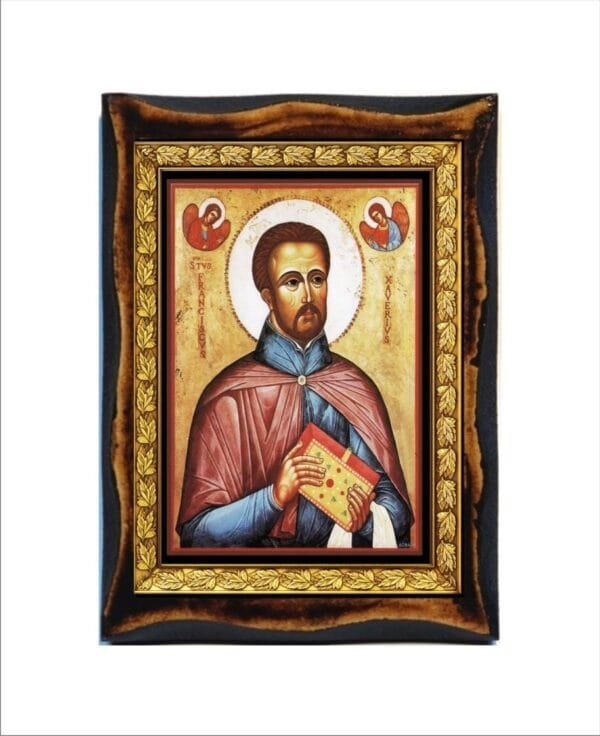





Francis Xavier
Our company offers wholesale sales for Monasteries, Exhibitions, Ecclesiastical Stores, Gift Shops, and Merchants. We provide competitive pricing based on the quantities you order, ensuring the best possible offer to meet your needs.
For more details on our products and to receive personalized offers, please contact us directly. We are happy to discuss terms and provide the best solutions tailored to you.
Francesco Saverio – François Xavier – Francisco Javier – Francisco Xavier – Franz Xaver – Franciscus Xaverius – Francisco
Dimensions: 11 x 8 cm – 4.33”x3.14”in , 15 x 11 cm – 5.9”x4.33”in , 21 x 15 cm – 8.3”x5.9”in , 27 x 21 cm – 10.6” X8.3”in – 42 x 32 cm – 16.5“x12.60”in
| Title | Range | Sale price |
|---|---|---|
| Total items | 5 - 10 | 15,20 € |
| Total items | 11 - 30 | 13,60 € |
| Total items | 31 - 60 | 12,00 € |
| Total items | 61 - 150 | 10,40 € |

Description
Francis Xavier, S.J. (/ˈzeɪviər, ˈzævi-/; born Francisco de Jasso y Azpilicueta; Latin Franciscus Xaverius; Basque: Frantzisko Xabierkoa; Spanish: Francisco Javier; 7 April 1506 – 3 December 1552), was a Navarrese Basque Roman Catholic missionary, who was a co-founder of the Society of Jesus.
Born in Javier (Xavier in Navarro-Aragonese or Xabier in Basque), Kingdom of Navarre (in present day Spain), he was a companion of Saint Ignatius of Loyola and one of the first seven Jesuits who took vows of poverty and chastity at Montmartre, Paris, in 1534. He led an extensive mission into Asia, mainly in the Portuguese Empire of the time and was influential in evangelization work, most notably in India. The Goa Inquisition was proposed by St. Francis Xavier. He also was the first Christian missionary to venture into Japan, Borneo, the Maluku Islands, and other areas. In those areas, struggling to learn the local languages and in the face of opposition, he had less success than he had enjoyed in India. Xavier was about to extend his missionary preaching to China when he died on Shangchuan Island.
He was beatified by Pope Paul V on 25 October 1619 and canonized by Pope Gregory XV on 12 March 1622. In 1624 he was made co-patron of Navarre. Known as the “Apostle of the Indies” and “Apostle of Japan”, he is considered to be one of the greatest missionaries since Paul the Apostle. In 1927, Pope Pius XI published the decree “Apostolicorum in Missionibus” naming Francis Xavier, along with Thérèse of Lisieux, co-patron of all foreign missions. He is now co-patron saint of Navarre with Fermin. The Day of Navarre in Navarre, Spain, marks nowadays the anniversary of Francis Xavier’s death, on 3 December 1552.
Francis Xavier was born in the royal castle of Xavier, in the Kingdom of Navarre, on 7 April 1506 according to a family register. He was the youngest son of Juan de Jasso y Atondo, seneschal of Xavier castle, who belonged to a prosperous farming family and had acquired a doctorate in law at the University of Bologna. Basque and Romance were his two mother tongues. Juan later became privy counsellor and finance minister to King John III of Navarre (Jean d’Albret). Francis’s mother was Doña María de Azpilcueta y Aznárez, sole heiress of two noble Navarrese families. He was through her related to the great theologian and philosopher Martín de Azpilcueta.
In 1512, Ferdinand, King of Aragon and regent of Castile, invaded Navarre, initiating a war that lasted over 18 years. Three years later, Francis’s father died when Francis was only nine years old. In 1516, Francis’s brothers participated in a failed Navarrese-French attempt to expel the Spanish invaders from the kingdom. The Spanish Governor, Cardinal Cisneros, confiscated the family lands, demolished the outer wall, the gates, and two towers of the family castle, and filled in the moat. In addition, the height of the keep was reduced by half. Only the family residence inside the castle was left. In 1522 one of Francis’s brothers participated with 200 Navarrese nobles in dogged but failed resistance against the Castilian Count of Miranda in Amaiur, Baztan, the last Navarrese territorial position south of the Pyrenees.
Additional Information
| Weight | N/A |
|---|---|
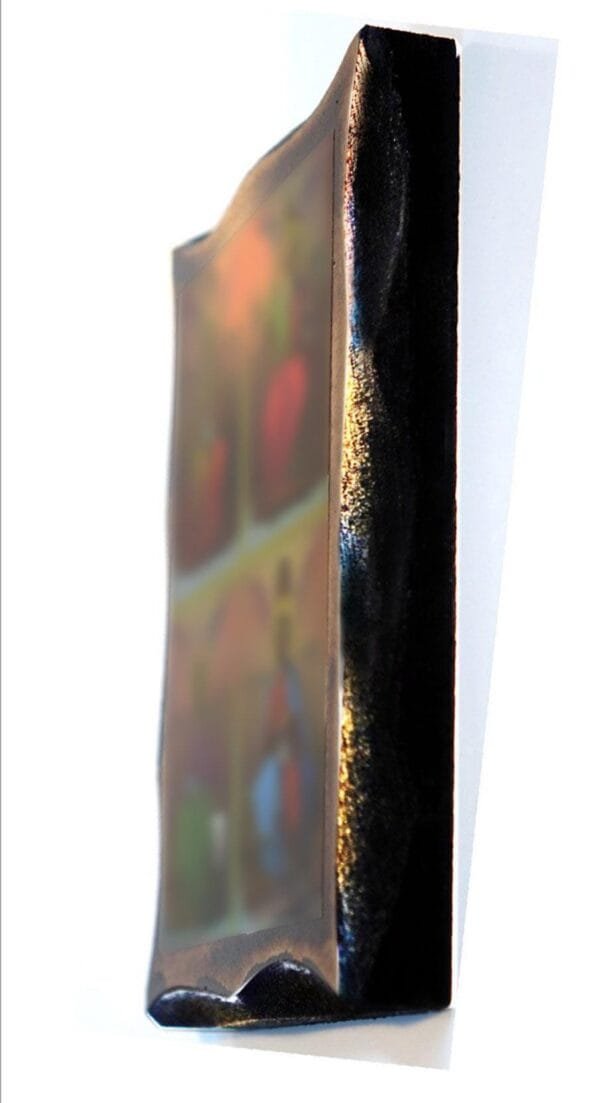
| Dimensions | 11cm x 8cm x 1.2cm, 15cm x 11cm x 1.7cm, 21cm x 15cm x 1.7cm, 27cm x 21cm x 1.7cm, 42cm x 32cm x 1.7cm |
There are no question found.



Rating & Review
There are no reviews yet.