
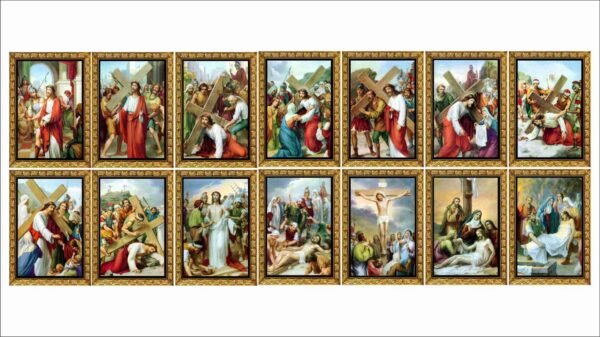
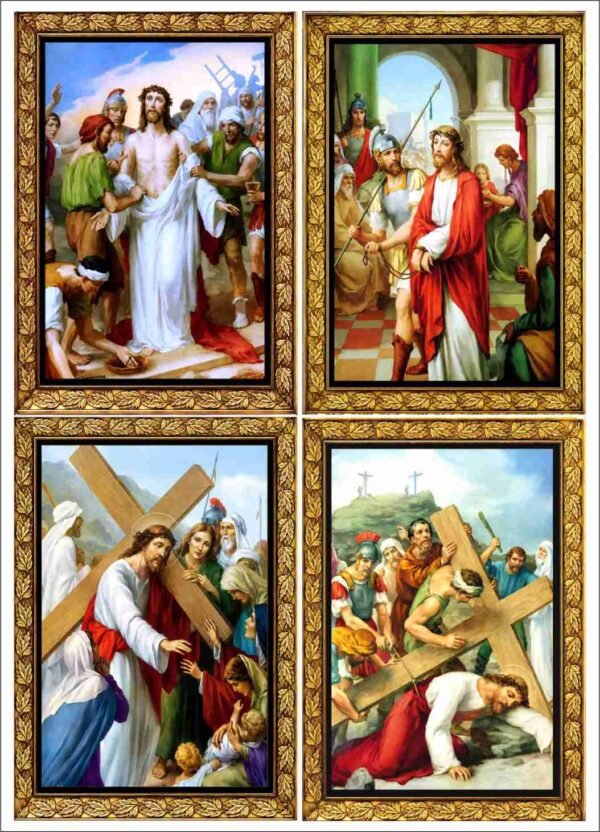
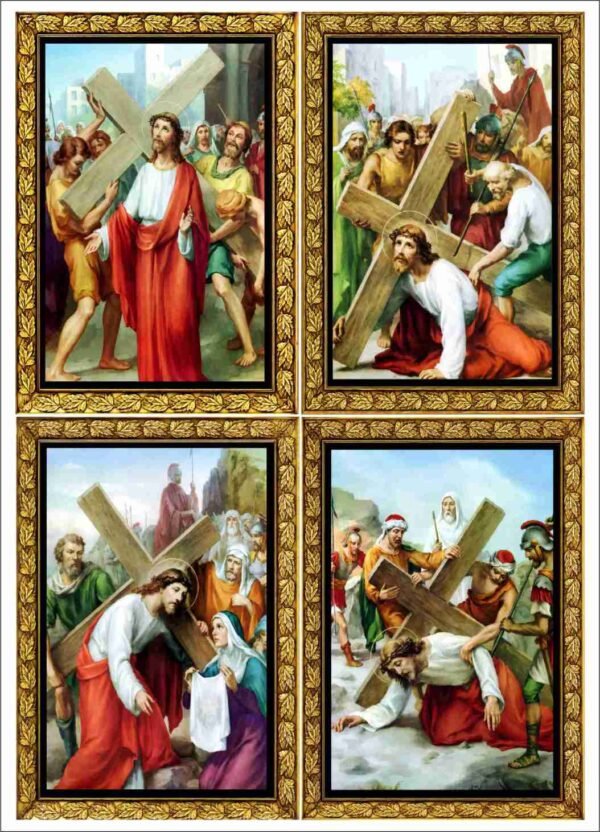
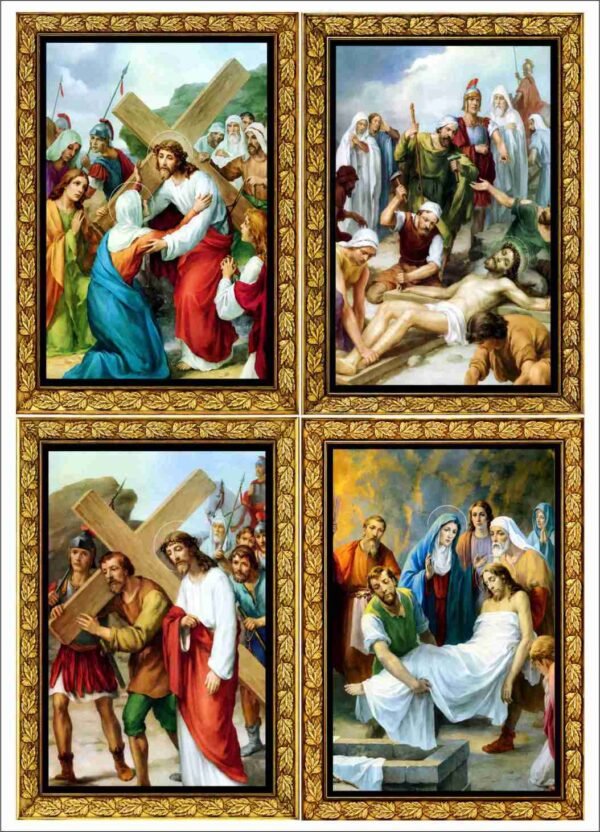
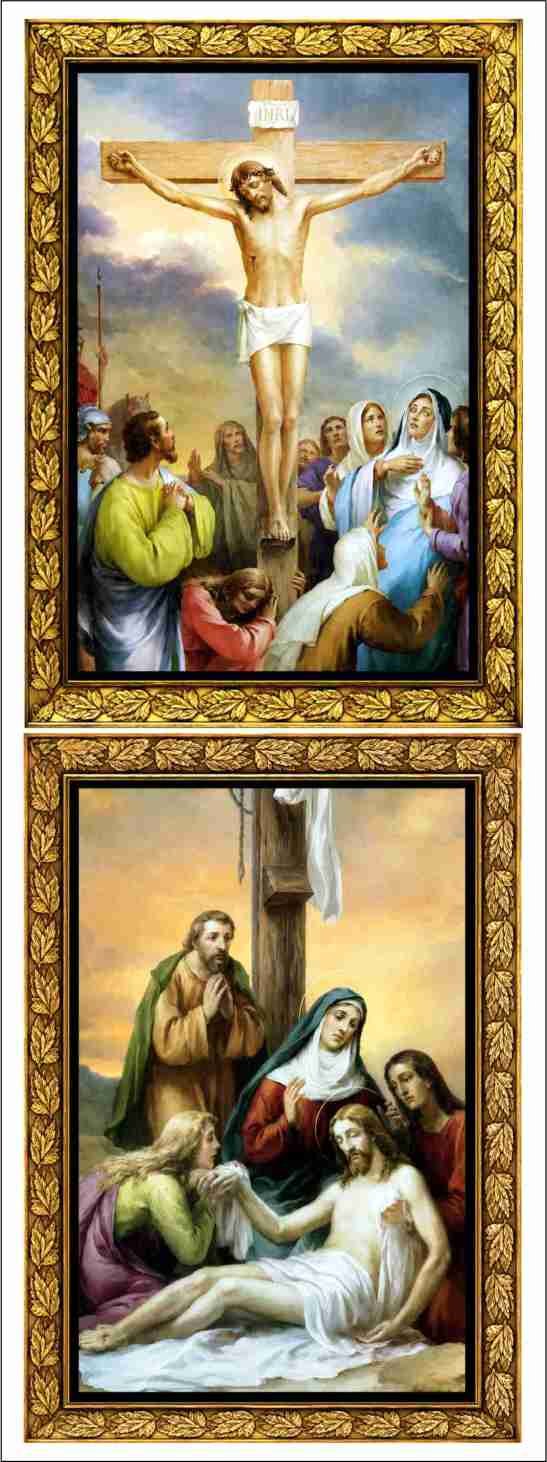

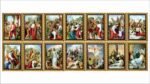
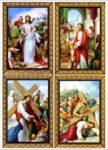
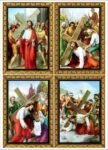
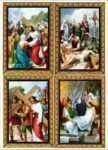
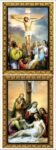

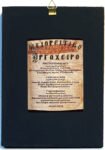
14 Stations of the Cross – Via Crucis Jesus Christ
Our company offers wholesale sales for Monasteries, Exhibitions, Ecclesiastical Stores, Gift Shops, and Merchants. We provide competitive pricing based on the quantities you order, ensuring the best possible offer to meet your needs.
For more details on our products and to receive personalized offers, please contact us directly. We are happy to discuss terms and provide the best solutions tailored to you.
Via Dolorosa – Chemin de croix – The Crucifixion Road – The Road to the Calvary – Via Crucis – Calea Crucii – Calvary
We offer you 14 Icons of the Via Dolorosa at the value of 12 pieces!!!!
Special offer: 11 x 8 cm – 4.33”x 3.14”in – 14 pieces x 16 euros = 224 you win 32 euros
15 x 11 cm – 5.9”x 4.33”in – 14 pieces x 21 euros = 252 you win 42 euros
21 x 15 cm – 8.3”x 5.9”in – 14 pieces x 29 euros = 406 you win 58 euros
27 x 21 cm – 10.6”X8.3”in – 14 pieces x 39 euros = 546 you win 78 euros
42 x 32 cm – 16.5“x12.60”in – 14 pieces x 83 euros = 1162 you win 166 euros
| Title | Range | Sale price |
|---|---|---|
| Total items | 5 - 10 | 182,40 € |
| Total items | 11 - 30 | 163,20 € |
| Total items | 31 - 60 | 144,00 € |
| Total items | 61 - 150 | 124,80 € |

Description
The Via Dolorosa (Latin for ‘Sorrowful Way’, often translated ‘Way of Suffering’; Arabic: طريق الآلام; Hebrew: ויה דולורוזה) is a processional route in the Old City of Jerusalem. It represents the path that Jesus took, forced by the Roman soldiers, on the way to his crucifixion. The winding route from the former Antonia Fortress to the Church of the Holy Sepulchre—a distance of about 600 metres (2,000 ft) —is a celebrated place of Christian pilgrimage. The current route has been established since the 18th century, replacing various earlier versions. It is today marked by 14 Stations of the Cross, nine of which are outside, in the streets, with the remaining five stations being currently inside the Church of the Holy Sepulchre.
The Via Dolorosa is not one street, but a route consisting of segments of several streets. One of the main segments is the modern remnant of one of the two main east-west routes (Decumanus Maximus) through the Roman city of Aelia Capitolina, as built by Hadrian. Standard Roman city design places the main east-west road through the middle of the city, but the presence of the Temple Mount along much of the eastern side of the city required Hadrian’s planners to add an extra east-west road at its north. In addition to the usual central north-south road (Cardo Maximus), which in Jerusalem headed straight up the western hill, a second major north-south road was added down the line of the Tyropoeon Valley; these two cardines converge near the Damascus Gate, close to the Via Dolorosa. If the Via Dolorosa had continued west in a straight line across the two routes, it would have formed a triangular block too narrow to construct standard buildings; the decumanus (now the Via Dolorosa) west of the Cardo was constructed south[dubious – discuss] of its eastern portion, creating the discontinuity in the road still present today.
Additional Information
| Weight | N/A |
|---|---|
| Dimensions | 11cm x 8cm x 1.2, 15cm x 11cm x 1.7, 21cm x 15cm x 1.7, 27cm x 21cm x 1.7, 42cm x 32cm x1.7cm |
There are no question found.
Related products


Saint Layla

Saint Longinus
Seller




Rating & Review
There are no reviews yet.