




Saint Grammatiki
Our company offers wholesale sales for Monasteries, Exhibitions, Ecclesiastical Stores, Gift Shops, and Merchants. We provide competitive pricing based on the quantities you order, ensuring the best possible offer to meet your needs.
For more details on our products and to receive personalized offers, please contact us directly. We are happy to discuss terms and provide the best solutions tailored to you.
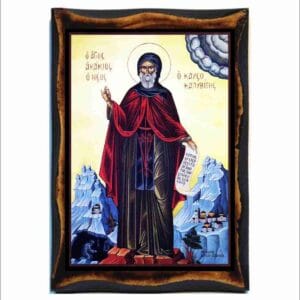
Saint Grammatike -Santa Grammatiki -Santa Grammatike Handmade Wood Icon on plaque with physical aging and Golden Leaf 24K
Dimensions of wooden plaque in inches : 10 X 13 cm – 5.11″ x 3.93″ inches – 18 x 13 cm – 7.08″ x 5.11″ inches – 24 x 18 cm – 9.45″x 7.08″ inches – 30 x 24 cm – 11.81″ x 9.45″ – 42 x 32 cm – 16.53″x12.59″ inches
| Title | Range | Sale price |
|---|---|---|
| Total items | 5 - 10 | 28,50 € |
| Total items | 11 - 30 | 25,50 € |
| Total items | 31 - 60 | 22,50 € |
| Total items | 61 - 150 | 19,50 € |

Description
Saint Grammatikē was a young girl who lived during the period of the early Christian persecutions in the Roman Empire. She hailed from Greece and belonged to a family of devout Christians, who taught her to follow Christ with faith and devotion. She was known for the purity of her heart and her deep faith, which led her to become a martyr in the Orthodox Church.
During the Christian persecutions by the Roman emperor, Saint Grammatikē was sentenced to torture and death for her belief in Christ. Despite being young and physically weak, Saint Grammatikē was unwavering in her trials, remaining faithful until the very end. She did not succumb to pressure to deny her faith, but instead, she welcomed death with the hope of eternal life.
The memory of Saint Grammatikē is inseparably linked to the faith and sacrifice of the martyrs in the Orthodox Church. The Church of Greece honors her as an example of devotion to Christ and the faith of the Gospel, and her memory is celebrated on the feast day of All Saints, a feast that commemorates all the saints who gave their lives for the faith.
The feast of Saint Grammatikē is part of the broader tradition of the Church, which honors all the martyrs who, through their deaths, showed the true path of faith and salvation. Every year, on the feast of All Saints, the faithful gather in churches to honor the lives and sacrifices of these saints, drawing strength from their faith and courage.
This Icon is a copy of the Hagiography (Holy Card Printing) that we have made in our Laboratory and we reserve the exclusive rights to reproduce these images, which are protected by copyright.
All Saints’ Day, also known as All Hallows’ Day, Hallowmas, the Feast of All Saints, or Solemnity of All Saints, is a Christian festival celebrated in honour of all the saints, known and unknown. In Western Christianity, it is celebrated on 1 November by the Roman Catholic Church, the Anglican Communion, the Methodist Church, the Lutheran Church, the Reformed Church, and other Protestant churches. The Eastern Orthodox Church and associated Eastern Catholic Churches and Byzantine Lutheran Churches celebrate it on the first Sunday after Pentecost. Oriental Orthodox churches of Chaldea and associated Eastern Catholic churches celebrate All Saints’ Day on the first Friday after Easter.
In the Western Christian practice, the liturgical celebration begins at Vespers on the evening of 31 October, All Hallows’ Eve (All Saints’ Eve), and ends at the close of 1 November. It is thus the day before All Souls’ Day, which commemorates the faithful departed. In many traditions, All Saints’ Day is part of the season of Allhallowtide, which includes the three days from 31 October to 2 November inclusive and in some denominations, such as Anglicanism, extends to Remembrance Sunday. On All Saints Day, it is common for families to attend church, as well as visit cemeteries in order to lay flowers and candles on the graves of their deceased loved ones. In Austria and Germany, godparents gift their godchildren Allerheiligenstriezel (All Saint’s Braid) on All Saint’s Day, while the practice of souling remains popular in Portugal. It is a national holiday in many historically Christian countries.
Additional Information
| Weight | N/A |
|---|---|
| Dimensions | 13cm x 10cm x 1.7cm, 18cm x 13cm x 1.7cm, 24cm x 18cm x 1.7cm, 30cm x 24cm x 1.7cm, 42cm x 32cm x 1.7cm |
There are no question found.




Rating & Review
There are no reviews yet.