
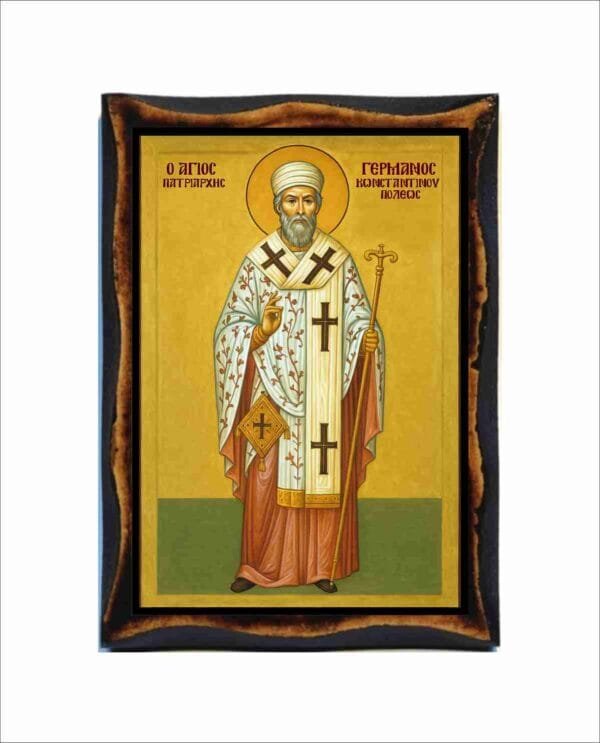


Germanus of Auxerre
Our company offers wholesale sales for Monasteries, Exhibitions, Ecclesiastical Stores, Gift Shops, and Merchants. We provide competitive pricing based on the quantities you order, ensuring the best possible offer to meet your needs.
For more details on our products and to receive personalized offers, please contact us directly. We are happy to discuss terms and provide the best solutions tailored to you.
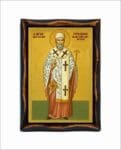
Saint Germanus – Auxerre Bishop – Roman – Catholic – Christian – Icon on Wood
Dimensions: 11 x 8 cm – 4.33”x3.14”in , 15 x 11 cm – 5.9”x4.33”in , 21 x 15 cm – 8.3”x5.9”in , 27 x 21 cm – 10.6” X8.3”in – 42 x 32 cm – 16.5“x12.60”in
| Title | Range | Sale price |
|---|---|---|
| Total items | 5 - 10 | 15,20 € |
| Total items | 11 - 30 | 13,60 € |
| Total items | 31 - 60 | 12,00 € |
| Total items | 61 - 150 | 10,40 € |

Description
Germanus of Auxerre (Welsh: Garmon Sant) (c. 378 – c. 448) was a bishop of Auxerre in Late Antique Gaul. He abandoned a career as a high-ranking government official to devote his formidable energy towards the promotion of the church and the protection of his ‘flock’ in dangerous times: personally confronting, for instance, the barbarian king, “Goar”. In Britain he is best remembered for his journey to combat Pelagianism in or around 429 AD, and the records of this visit provide valuable information on the state of post-Roman British society. He also played an important part in the establishment and promotion of the Cult of Saint Alban. The saint was said to have revealed the story of his martyrdom to Germanus in a dream or holy vision, and Germanus ordered this to be written down for public display. Germanus is venerated as a saint in both the Roman Catholic and Orthodox churches, which commemorate him on July 31.
The principal source for the events of his life is the Vita Germani, a hagiography written by Constantius of Lyon around 480, and a brief passage added onto the end of the Passio Albani, which may possibly have been written or commissioned by Germanus. Constantius was a friend of Bishop Lupus of Troyes, who accompanied Germanus to Britain, which provided him with a link to Germanus.
Additional Information
| Weight | N/A |
|---|---|
| Dimensions | 11cm x 8cm x 1.2cm, 15cm x 11cm x 1.7cm, 21cm x 15cm x 1.7cm, 27cm x 21cm x 1.7cm, 42cm x 32cm x 1.7cm |
There are no question found.



Rating & Review
There are no reviews yet.