




Saint Benedict
Our company offers wholesale sales for Monasteries, Exhibitions, Ecclesiastical Stores, Gift Shops, and Merchants. We provide competitive pricing based on the quantities you order, ensuring the best possible offer to meet your needs.
For more details on our products and to receive personalized offers, please contact us directly. We are happy to discuss terms and provide the best solutions tailored to you.
Benedict of Nursia – Benedetto da Norcia – San Benedetto – Benoît de Nursie – Benito de Nursia – Benedikt von Nursia
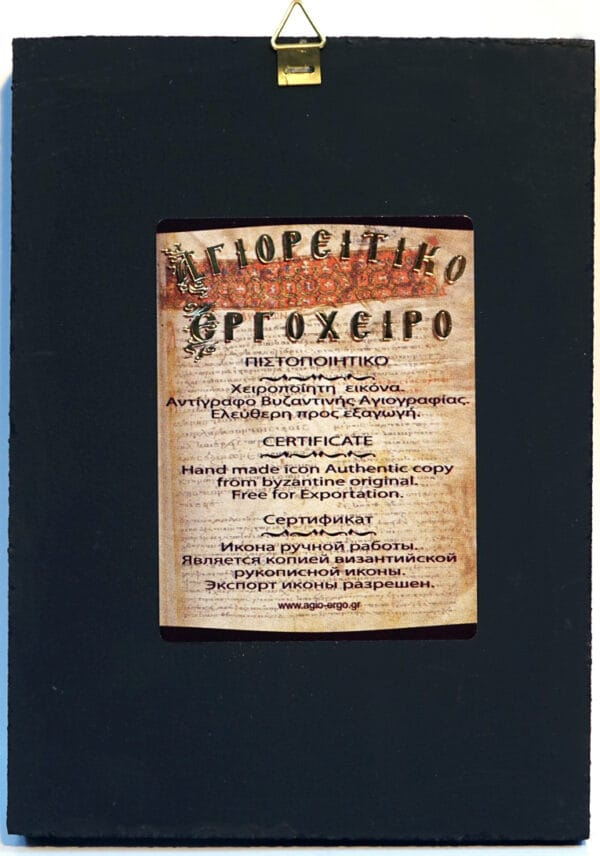
Dimensions: 11 x 8 cm – 4.33”x3.14”in , 15 x 11 cm – 5.9”x4.33”in , 21 x 15 cm – 8.3”x5.9”in , 27 x 21 cm – 10.6” X8.3”in – 42 x 32 cm – 16.5“x12.60”in
| Title | Range | Sale price |
|---|---|---|
| Total items | 5 - 10 | 15,20 € |
| Total items | 11 - 30 | 13,60 € |
| Total items | 31 - 60 | 12,00 € |
| Total items | 61 - 150 | 10,40 € |

Description
Benedict of Nursia (Latin: Benedictus Nursiae; Italian: Benedetto da Norcia; 2 March 480 – 21 March 547), often known as Saint Benedict, was an Italian Catholic monk. He is famed in the Catholic Church, the Eastern Orthodox Church, the Lutheran Churches, the Anglican Communion, and Old Catholic Churches.[3][4] In 1964 Pope Paul VI declared Benedict a patron saint of Europe.[5]
Benedict founded twelve communities for monks at Subiaco in present-day Lazio, Italy (about 65 kilometres (40 mi) to the east of Rome), before moving further south-east to Monte Cassino in the mountains of central Italy. The present-day Order of Saint Benedict emerged later and, moreover, is not an “order” as the term is commonly understood, but a confederation of autonomous congregations.
Benedict’s main achievement, his Rule of Saint Benedict, contains a set of rules for his monks to follow. Heavily influenced by the writings of John Cassian (c. 360 – c. 435), it shows strong affinity with the earlier Rule of the Master, but it also has a unique spirit of balance, moderation and reasonableness (ἐπιείκεια, epieíkeia), which persuaded most Christian religious communities founded throughout the Middle Ages to adopt it. As a result, Benedict’s Rule became one of the most influential religious rules in Western Christendom. For this reason, Giuseppe Carletti regarded Benedict as the founder of Western Christian monasticism.
Additional Information
| Weight | N/A |
|---|---|
| Dimensions | 11cm x 8cm x 1.2cm, 15cm x 11cm x 1.7cm, 21cm x 15cm x 1.7cm, 27cm x 21cm x 1.7cm, 42cm x 32cm x 1.7cm |
There are no question found.




Rating & Review
There are no reviews yet.