
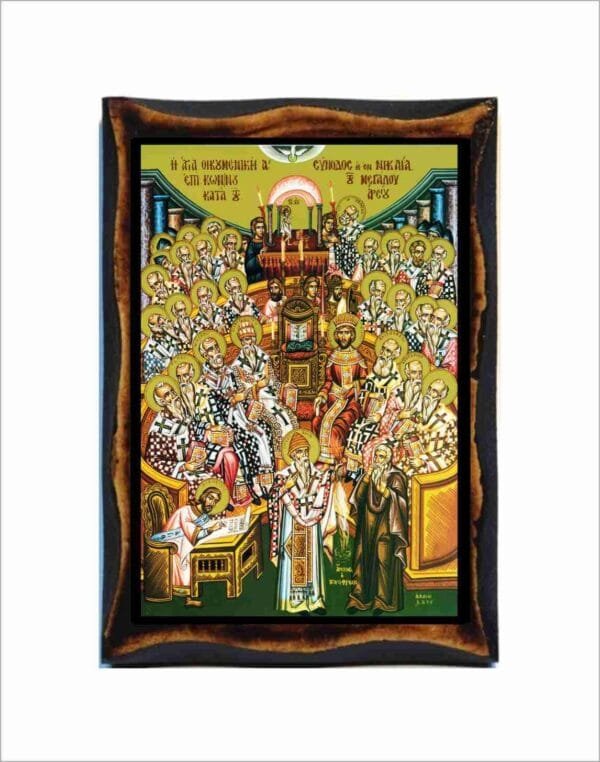





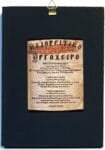
Council of Nicaea
Our company offers wholesale sales for Monasteries, Exhibitions, Ecclesiastical Stores, Gift Shops, and Merchants. We provide competitive pricing based on the quantities you order, ensuring the best possible offer to meet your needs.
For more details on our products and to receive personalized offers, please contact us directly. We are happy to discuss terms and provide the best solutions tailored to you.
Concilio di Nicea I – Premier concile de Nicée – Premier concile de Nicée – Erstes Konzil von Nicäa – Primul conciliu
Dimensions: 11 x 8 cm – 4.33”x3.14”in , 15 x 11 cm – 5.9”x4.33”in , 21 x 15 cm – 8.3”x5.9”in , 27 x 21 cm – 10.6” X8.3”in – 42 x 32 cm – 16.5“x12.60”in
| Title | Range | Sale price |
|---|---|---|
| Total items | 5 - 10 | 15,20 € |
| Total items | 11 - 30 | 13,60 € |
| Total items | 31 - 60 | 12,00 € |
| Total items | 61 - 150 | 10,40 € |

Description
The First Council of Nicaea (/naɪˈsiːə/ ny-SEE-ə; Ancient Greek: Σύνοδος τῆς Νίκαιας, romanized: Sýnodos tês Níkaias) was a council of Christian bishops convened in the Bithynian city of Nicaea (now İznik, Turkey) by the Roman Emperor Constantine I. The Council of Nicaea met from May until the end of July 325.
This ecumenical council was the first of many efforts to attain consensus in the church through an assembly representing all Christendom. Hosius of Corduba may have presided over its deliberations. Its main accomplishments were settlement of the Christological issue of the divine nature of God the Son and his relationship to God the Father, the construction of the first part of the Nicene Creed, mandating uniform observance of the date of Easter, and promulgation of early canon law.
The major impetus for the calling of the Council of Nicaea arose in a theological dispute among the Christian clergy of Alexandria concerning the nature of Jesus, his origin, and relation to God the Father. Scholars propose dates between 318 and 322 for the beginning of the dispute. The precise origins of the controversy are unclear, but the principal actors were Archbishop Alexander of Alexandria and the presbyter Arius. Arius’ teachings are known partially from a few pieces of his writing which survive, but principally from his opponents, primarily Alexander and Athanasius of Alexandria. Arius criticized Alexander’s teachings on Christology; Alexander taught that Jesus as God the Son was eternally generated from the Father, while Arius and his followers asserted that the Father alone was eternal, and that the Son was created or begotten by the Father, and thus had a defined point of origin and was subordinate to the Father. Arius accused Alexander of following the teachings of Sabellius, who taught that the Father, Son, and Holy Spirit were one person, rather than the view held throughout the east that they were distinct. Alexander called a local council of bishops from Egypt and Libya, which sided with Alexander’s view. Arius refused to subscribe to the council’s decision, and he and several followers were excommunicated and exiled from Alexandria by Alexander. Arius then traveled to churches around the Roman east and wrote to bishops to gain support of his view. Among Arius’ supporters were Eusebius of Nicomedia and Eusebius of Caesarea, and they advocated for his view and his restoration to the church in Alexandria. Alexander also circulated letters defending his own position.
Additional Information
| Weight | N/A |
|---|---|
| Dimensions | 11cm x 8cm x 1.2cm, 15cm x 11cm x 1.7cm, 21cm x 15cm x 1.7cm, 27cm x 21cm x 1.7cm, 42cm x 32cm x 1.7cm |
There are no question found.




Rating & Review
There are no reviews yet.