
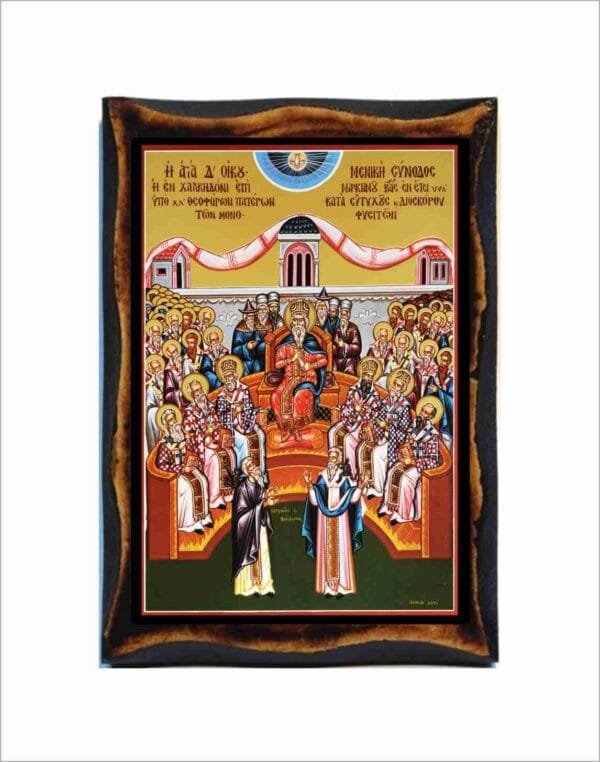

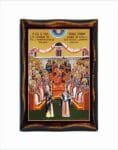
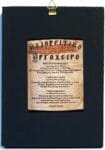
Council of Chalcedon
Our company offers wholesale sales for Monasteries, Exhibitions, Ecclesiastical Stores, Gift Shops, and Merchants. We provide competitive pricing based on the quantities you order, ensuring the best possible offer to meet your needs.
For more details on our products and to receive personalized offers, please contact us directly. We are happy to discuss terms and provide the best solutions tailored to you.
Concilio di Calcedonia – Concile de Chalcédoine – Konzil von Chalcedon – Conciliul de la Calcedon – Concilio de Calcedonia
Dimensions: 11 x 8 cm – 4.33”x3.14”in , 15 x 11 cm – 5.9”x4.33”in , 21 x 15 cm – 8.3”x5.9”in , 27 x 21 cm – 10.6” X8.3”in – 42 x 32 cm – 16.5“x12.60”in
| Title | Range | Sale price |
|---|---|---|
| Total items | 5 - 10 | 15,20 € |
| Total items | 11 - 30 | 13,60 € |
| Total items | 31 - 60 | 12,00 € |
| Total items | 61 - 150 | 10,40 € |

Description
The Council of Chalcedon (/kælˈsiːdən, ˈkælsɪdɒn/; Latin: Concilium Chalcedonense)[a] was the fourth ecumenical council of the Christian Church. It was convoked by the Roman emperor Marcian. The council convened in the city of Chalcedon, Bithynia (modern-day Kadıköy, Istanbul, Turkey) from 8 October to 1 November 451. The council was attended by over 520 bishops or their representatives, making it the largest and best-documented of the first seven ecumenical councils. The principal purpose of the council was to re-assert the teachings of the ecumenical Council of Ephesus against the teachings of Eutyches and Nestorius. Such doctrines viewed Christ’s divine and human natures as separate (Nestorianism) or viewed Christ as solely divine (monophysitism).
The situation continued to deteriorate, with Leo demanding the convocation of a new council and Emperor Theodosius II refusing to budge, all the while appointing bishops in agreement with Dioscorus. All this changed dramatically with the Emperor’s death and the elevation of Marcian to the imperial throne. To resolve the simmering tensions, Marcian announced his intention to hold a new council to set aside the 449 Second Council of Ephesus which was named the “Latrocinium” or “Robber Council” by Pope Leo. Pulcheria, the sister of Theodosius, may have influenced this decision, or even made the convention of a council a requirement during her negotiations with Aspar, the magister militum, to marry Marcian.[citation needed]
Leo had pressed for it to take place in Italy, but Emperor Marcian instead called for it to convene at Chalcedon, because it was closer to Constantinople, and would thus allow him to respond quickly to any events along the Danube, which was being raided by the Huns under Attila.[citation needed]
The council opened on 8 October 451. Marcian had the bishops deposed by Dioscorus returned to their dioceses and had the body of Flavian brought to the capital to be buried honorably. The Emperor asked Leo to preside over the council, but Leo again chose to send legates in his place. This time, Bishops Paschasinus of Lilybaeum and Julian of Cos and two priests Boniface and Basil represented the western church at the council. The council was attended by about 520 bishops or their representatives and was the largest and best-documented of the first seven ecumenical councils. All the sessions were held in the church of St. Euphemia, Martyr, outside the city and directly opposite Constantinople. As to the number of sessions held by the Council of Chalcedon there is a great discrepancy in the various texts of the Acts, also in the ancient historians of the council. Either the respective manuscripts must have been incomplete; or the historians passed over in silence several sessions held for secondary purposes. According to the deacon Rusticus, there were in all sixteen sessions; this division is commonly accepted by scholars, including Karl Josef von Hefele, historian of the councils. If all the separate meetings were counted, there would be twenty-one sessions; several of these meetings, however, are considered as supplementary to preceding sessions.
Additional Information
| Weight | N/A |
|---|---|
| Dimensions | 11cm x 8cm x 1.2cm, 15cm x 11cm x 1.7cm, 21cm x 15cm x 1.7cm, 27cm x 21cm x 1.7cm, 42cm x 32cm x 1.7cm |
There are no question found.


Rating & Review
There are no reviews yet.