
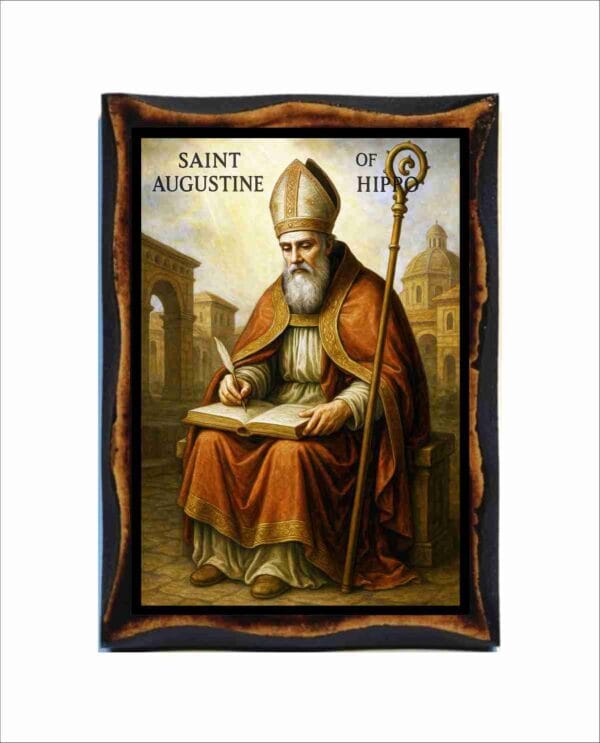






Augustine of Hippo
Our company offers wholesale sales for Monasteries, Exhibitions, Ecclesiastical Stores, Gift Shops, and Merchants. We provide competitive pricing based on the quantities you order, ensuring the best possible offer to meet your needs.
For more details on our products and to receive personalized offers, please contact us directly. We are happy to discuss terms and provide the best solutions tailored to you.
Saint Augustine – Santo Agostinho – San Agustín – Saint Augustin – Santo Agostino – Święty Augustyn – Sao Agostinho
Dimensions: 11 x 8 cm – 4.33”x3.14”in , 15 x 11 cm – 5.9”x4.33”in , 21 x 15 cm – 8.3”x5.9”in , 27 x 21 cm – 10.6” X8.3”in – 42 x 32 cm – 16.5“x12.60”in
| Title | Range | Sale price |
|---|---|---|
| Total items | 5 - 10 | 15,20 € |
| Total items | 11 - 30 | 13,60 € |
| Total items | 31 - 60 | 12,00 € |
| Total items | 61 - 150 | 10,40 € |

Description
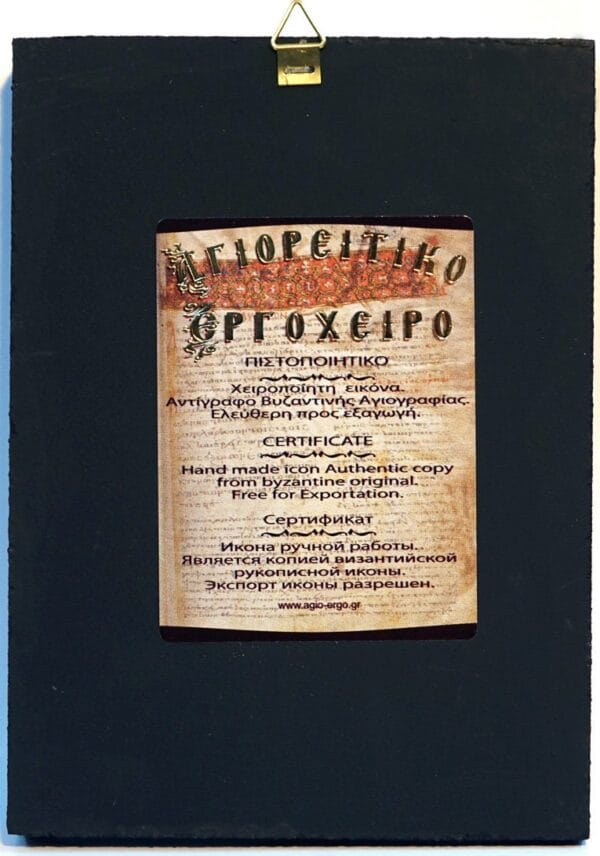
This Icon is a copy of the Hagiography (Holy Card Printing) that we have made in our Laboratory and we reserve the exclusive rights to reproduce these images, which are protected by copyright.
Augustine of Hippo (/ɔːˈɡʌstɪn/; 13 November 354 – 28 August 430 AD) was a Catholic bishop and theologian, a Roman African having Chaouis Berber origins, doctor of the Church, and Neoplatonic philosopher from Numidia whose writings influenced the development of the Western Church and Western philosophy, and indirectly all of Western Christianity. He was the bishop of Hippo Regius in North Africa and is viewed as one of the most important Church Fathers of the Latin Church for his writings in the Patristic Period. Among his most important works are The City of God, De doctrina Christiana, and Confessions.
According to his contemporary, Jerome, Augustine “established anew the ancient Faith”.[a] In his youth he was drawn to Manichaeism and later to neoplatonism. After his baptism and conversion to Christianity in 386, Augustine developed his own approach to philosophy and theology, accommodating a variety of methods and perspectives. Believing that the grace of Christ was indispensable to human freedom, he helped formulate the doctrine of original sin and made seminal contributions to the development of just war theory. When the Western Roman Empire began to disintegrate, Augustine imagined the Church as a spiritual City of God, distinct from the material Earthly City. His thoughts profoundly influenced the medieval worldview. The segment of the Church that adhered to the concept of the Trinity as defined by the Council of Nicaea and the Council of Constantinople closely identified with Augustine’s On the Trinity.
Augustine is recognized as a saint in the Catholic Church, the Eastern Orthodox Churches, and the Anglican Communion and as a preeminent Doctor of the Church. He is also the patron of the Augustinians. His memorial is celebrated on 28 August, the day of his death. Augustine is the patron saint of brewers, printers, theologians, and a number of cities and dioceses. Many Protestants, especially Calvinists and Lutherans, consider him to be one of the theological fathers of the Protestant Reformation due to his teachings on salvation and divine grace. Protestant Reformers generally, and Martin Luther in particular, held Augustine in preeminence among early Church Fathers. Luther himself was, from 1505 to 1521, a member of the Order of the Augustinian Eremites.
In the East, his teachings are more disputed, and were notably attacked by John Romanides. But other theologians and figures of the Eastern Orthodox Church have shown significant approbation of his writings, chiefly Georges Florovsky. The most controversial doctrine associated with him, the filioque, was rejected by the Eastern Orthodox Churches as heretic teaching. Other disputed teachings include his views on original sin, the doctrine of grace, and predestination. Nevertheless, though considered to be mistaken on some points, he is still considered a saint, and has even had influence on some Eastern Church Fathers, most notably Gregory Palamas. In the Eastern Orthodox Churches his feast day is celebrated on 15 June. Historian Diarmaid MacCulloch has written: “Augustine’s impact on Western Christian thought can hardly be overstated; only his beloved example Paul of Tarsus, has been more influential, and Westerners have generally seen Paul through Augustine’s eyes.”
Additional Information
| Weight | N/A |
|---|---|
| Dimensions | 11cm x 8cm x 1.2cm, 15cm x 11cm x 1.7cm, 21cm x 15cm x 1.7cm, 27cm x 21cm x 1.7cm, 42cm x 32cm x 1.7cm |
There are no question found.





Rating & Review
There are no reviews yet.