
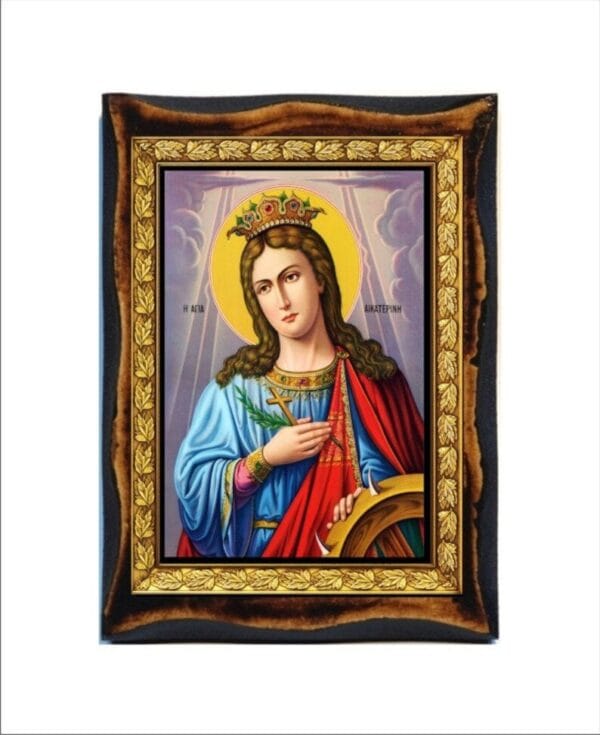







Catherine of Alexandria
Our store offers wholesale sales for Μonasteries, Εxhibitions, Ecclesiastical Stores, Gift Shops and Μerchants. We provide competitive pricing based on the quantities you order. For more details on our products and to receive customized offers, please contact us directly. We are happy to discuss terms and provide the best solutions tailored to your needs.
Katharine of Alexandria – Sainte Catherine – Santa Caterina – Santa Catarina – Catalina de Alejandría – Katharina
| Title | Range | Sale price |
|---|---|---|
| Total items | 5 - 10 | 15,20 € |
| Total items | 11 - 30 | 13,60 € |
| Total items | 31 - 60 | 12,00 € |
| Total items | 61 - 150 | 10,40 € |

Description
Catherine of Alexandria, or Katharine of Alexandria, also known as Saint Catherine of Alexandria, Saint Catherine of the Wheel and The Great Martyr Saint Catherine (Coptic: Ϯⲁⲅⲓⲁ Ⲕⲁⲧⲧⲣⲓⲛ; Greek: ἡ Ἁγία Αἰκατερίνη ἡ Μεγαλομάρτυς “Holy Catherine the Great Martyr”; Latin: Catharina Alexandrina), is, according to tradition, a Christian saint and virgin, who was martyred in the early 4th century at the hands of the emperor Maxentius. According to her hagiography, she was both a princess and a noted scholar who became a Christian around the age of 14, converted hundreds of people to Christianity and was martyred around the age of 18. More than 1,100 years after Catherine’s martyrdom, Joan of Arc identified her as one of the saints who appeared to and counselled her.
The Eastern Orthodox Church venerates her as a Great Martyr and celebrates her feast day on 24 or 25 November, depending on the regional tradition. In Catholicism, Catherine is traditionally revered as one of the Fourteen Holy Helpers and she is commemorated in the Roman Martyrology on 25 November. Her feast was removed from the General Roman Calendar in 1969, but restored in 2002 as an optional memorial.
Some modern scholars consider that the legend of Catherine was probably based on the life and murder of the Greek philosopher Hypatia, with reversed roles of Christians and pagans.
According to the traditional narrative, Catherine was the daughter of Constus, the governor of Alexandria during the reign of the emperor Maximian (286–305). From a young age she devoted herself to study. A vision of Mary and Baby Jesus persuaded her to become a Christian. When the persecutions began under Maxentius, she went to the emperor and rebuked him for his cruelty. The emperor summoned 50 of the best pagan philosophers and orators to dispute with her, hoping that they would refute her pro-Christian arguments, but Catherine won the debate. Several of her adversaries, conquered by her eloquence, declared themselves Christians and were at once put to death.
Catherine was then scourged and imprisoned. She was scourged so cruelly and for so long that her whole body was covered with wounds, from which the blood flowed in streams. The spectators wept with pity, but Catherine stood with her eyes raised to heaven, without giving a sign of suffering or fear. Maxentius ordered her to be imprisoned without food, so she would starve to death. During the confinement, angels tended her wounds with salve. Catherine was fed daily by a dove from Heaven and Christ also visited her, encouraging her to fight bravely, and promised her the crown of everlasting glory.
During her imprisonment more than 200 people came to see her, including Maxentius’ wife, Valeria Maximilla; all converted to Christianity and were subsequently martyred. Twelve days later, when the dungeon was opened, a bright light and fragrant perfume filled it and Catherine came forth even more radiant and beautiful.
Upon the failure of Maxentius to make Catherine yield by way of torture, he tried to win the beautiful and wise princess over by proposing marriage. Catherine refused, declaring that her spouse was Jesus Christ, to whom she had consecrated her virginity.
The furious emperor condemned Catherine to death on a spiked breaking wheel, but, at her touch, it shattered. Maxentius ordered her to be beheaded. Catherine herself ordered the execution to commence. A milk-like substance rather than blood flowed from her neck.
Additional Information
| Weight | N/A |
|---|---|
| Dimensions | 11cm x 8cm x 1.2cm, 15cm x 11cm x 1.7cm, 21cm x 15cm x 1.7cm, 27cm x 21cm x 1.7cm, 42cm x 32cm x 1.7cm |
There are no question found.


Rating & Review
There are no reviews yet.