


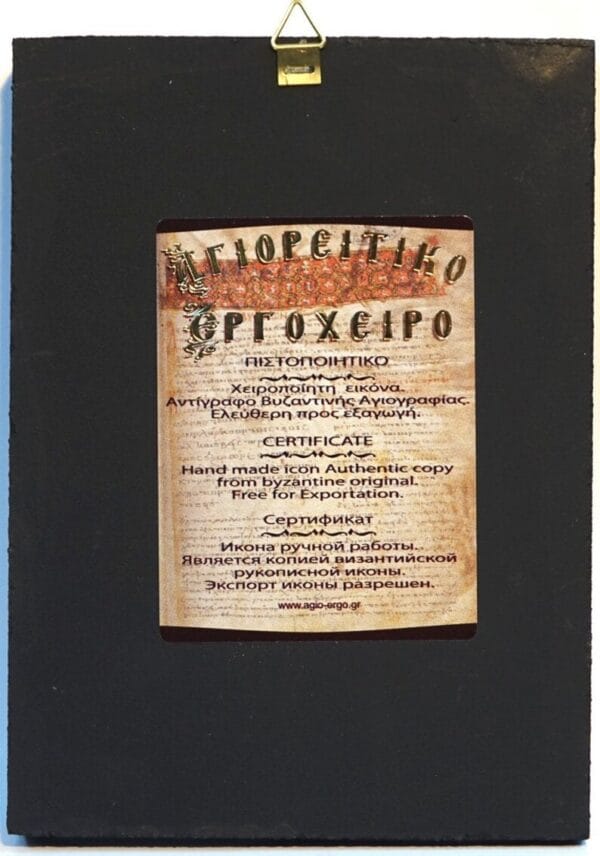

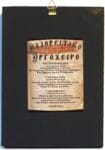


Great Martyr Barbara
Our company offers wholesale sales for Monasteries, Exhibitions, Ecclesiastical Stores, Gift Shops, and Merchants. We provide competitive pricing based on the quantities you order, ensuring the best possible offer to meet your needs.
For more details on our products and to receive personalized offers, please contact us directly. We are happy to discuss terms and provide the best solutions tailored to you.
Sainte Barbe – Sainte Barbara – Sainte Barbare – Saint Barbara – Santa Barbara – Barbara von Nikomedien – Barbara
Dimensions: 11 x 8 cm – 4.33”x3.14”in , 15 x 11 cm – 5.9”x4.33”in , 21 x 15 cm – 8.3”x5.9”in , 27 x 21 cm – 10.6” X8.3”in – 42 x 32 cm – 16.5“x12.60”in
| Title | Range | Sale price |
|---|---|---|
| Total items | 5 - 10 | 15,20 € |
| Total items | 11 - 30 | 13,60 € |
| Total items | 31 - 60 | 12,00 € |
| Total items | 61 - 150 | 10,40 € |

Description
St Barbara was also the Patron saint of the Royal Army Ordnance Corps of the British Army, a church being dedicated to her initial at Hilsea Barracks Portsmouth later being moved to Backdown in Surrey, when the Corps moved its training establishment there.
The Irish Army venerates her as the patron saint of the Artillery Corps where she appears on the corps insignia, half dressed, holding a harp, sitting on a field cannon.
In Germany, Saint Barbara is revered as a patron saint of miners and in extension, the geosciences in general, including the tunelling industry.
In the Czech Republic, a statue of Saint Barbara is placed near the future tunnel portal during the groundbreaking ceremony of most major tunneling projects, owing to her being the patron saint of miners.[citation needed].
In Poland, the salt mine at Wieliczka honours Saint Barbara in Saint Kinga’s chapel.
The Spanish military artillerymen, mining engineers and miners also venerate her as patron saint. Parades, masses, dinners and other activities are held in her honour.
Saint Barbara (Greek: Αγία Βαρβάρα, Coptic: Ϯⲁⲅⲓⲁ Ⲃⲁⲣⲃⲁⲣⲁ), Feast Day December 4, known in the Eastern Orthodox Church as the Great Martyr Barbara, was an early Christian Greek saint and martyr. Accounts place her in the 3rd century in Heliopolis of Phoenicia, present-day Baalbek, Lebanon. There is no reference to her in the authentic early Christian writings nor in the original recension of Saint Jerome’s martyrology. Her name can be traced to the 7th century, and veneration of her was common, especially in the East, from the 9th century.
Because of doubts about the historicity of her legend, she was removed from the General Roman Calendar in the 1969 revision, though not from the Catholic Church’s list of saints.
Saint Barbara is often portrayed with miniature chains and a tower. As one of the Fourteen Holy Helpers, Barbara continues to be a popular saint in modern times, perhaps best known as the patron saint of armourers, artillerymen, military engineers, miners and others who work with explosives because of her old legend’s association with lightning, and also of mathematicians. Many of the thirteen miracles in a 15th-century French version of her story turn on the security she offered that her devotees would not die without making confession and receiving extreme unction.
Additional Information
| Weight | N/A |
|---|---|
| Dimensions | 11cm x 8cm x 1.2cm, 15cm x 11cm x 1.7cm, 21cm x 15cm x 1.7cm, 27cm x 21cm x 1.7cm, 42cm x 32cm x 1.7cm |
There are no question found.




Rating & Review
There are no reviews yet.