
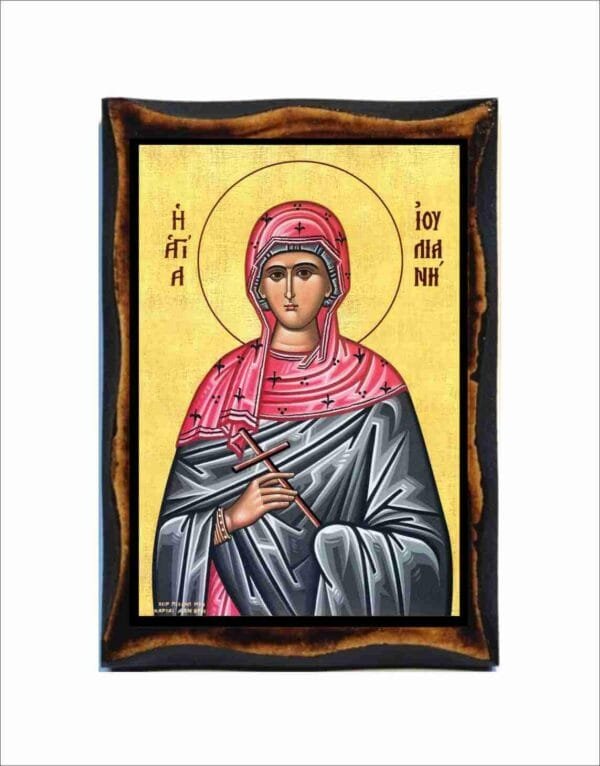
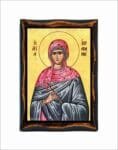

Juliana of Nicomedia
Our company offers wholesale sales for Monasteries, Exhibitions, Ecclesiastical Stores, Gift Shops, and Merchants. We provide competitive pricing based on the quantities you order, ensuring the best possible offer to meet your needs.
For more details on our products and to receive personalized offers, please contact us directly. We are happy to discuss terms and provide the best solutions tailored to you.
Giuliana di Nicomedia – Santa Giuliana – Juliana de Nicomedia – Julienne de Nicomédie – Juliana von Nikomedia – Julia
Dimensions: 11 x 8 cm – 4.33”x3.14”in , 15 x 11 cm – 5.9”x4.33”in , 21 x 15 cm – 8.3”x5.9”in , 27 x 21 cm – 10.6” X8.3”in – 42 x 32 cm – 16.5“x12.60”in
| Title | Range | Sale price |
|---|---|---|
| Total items | 5 - 10 | 12,87 £ |
| Total items | 11 - 30 | 11,51 £ |
| Total items | 31 - 60 | 10,16 £ |
| Total items | 61 - 150 | 8,81 £ |

Description
According to Kirsch, the Acts of Saint Juliana used by Bede in his “Martyrologium” are purely legendary. According to this account, Saint Juliana, daughter of an illustrious pagan named Africanus, was born in Nicomedia; and as a child was betrothed to the Senator Eleusius, one of the emperor’s advisors. Her father was hostile to the Christians. Juliana secretly accepted holy baptism. When the time of her wedding approached, Juliana refused to be married. Her father urged her not to break her engagement, but when she refused to obey him, he handed her over to the Governor, her former fiancé. Elusius again asked Juliana to marry him, but she again refused.
Juliana was beheaded after suffering torture in 304, during the persecution of Maximian. Another Christian named Barbara suffered the death of a martyr along with Juliana and was likewise sainted.
Soon after a noble lady named Sephonia came through Nicomedia and took the saint’s body with her to Italy, and had it buried in Campania. Evidently it was this alleged translation that caused the martyred Juliana, honoured in Nicomedia, to be identified with the Saint Juliana of Cumae evidenced above, although they are quite distinct persons.
Juliana’s parents were pagans and they wanted to betroth her with Eleusius, a prominent officer from Antioch, but Juliana denied strongly. Her denial left her parents surprised because until then she had never opposed them and she was an obedient daughter. Eleusius’ ego was sorely injured and he sought revenge. He made some queries and found out that Juliana had converted to Christianity, though her parents knew nothing about this. Eleusius impeached her before the Roman governor and as a result she was arrested and put in jail. While she was in prison, efforts to make her the wife of Eleusius continued, in order to save her from execution, but Juliana preferred to die rather than have a pagan as a husband. Then Eleusius after being ordered by the Roman governor and filled with hate flogged her in a ruthless way. After that, he burned her face with a heated iron and said at her, “Go now at the mirror to see your beauty”. Juliana answered him with a light smile: “At the resurrection of the righteous, there won’t exist burnings and wounds but only the soul. So Eleusius, I prefer to have now the wounds of the body which are temporary, rather than the wounds of the soul which torture eternal.” After a while, Juliana was beheaded. Eleusius was later eaten by a lion, when he was shipwrecked on an unknown island.
Additional Information
| Weight | N/A |
|---|---|
| Dimensions | 11cm x 8cm x 1.2cm, 15cm x 11cm x 1.7cm, 21cm x 15cm x 1.7cm, 27cm x 21cm x 1.7cm, 42cm x 32cm x 1.7cm |
There are no question found.






Rating & Review
There are no reviews yet.