
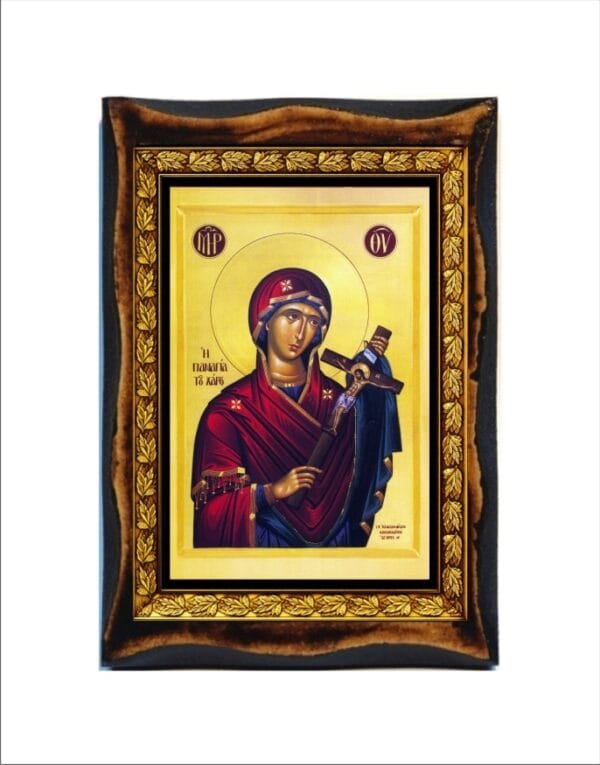

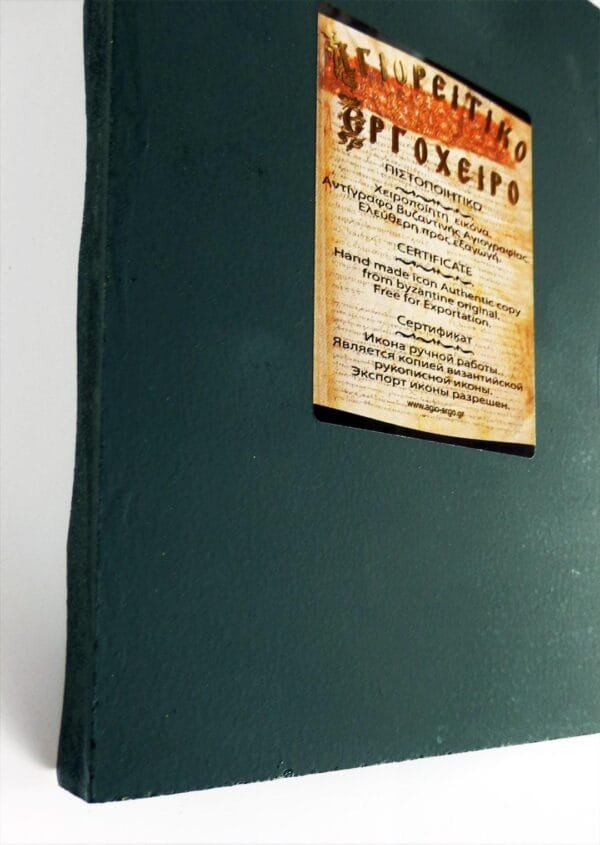



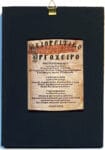
Our Lady of Charon
Our company offers wholesale sales for Monasteries, Exhibitions, Ecclesiastical Stores, Gift Shops, and Merchants. We provide competitive pricing based on the quantities you order, ensuring the best possible offer to meet your needs.
For more details on our products and to receive personalized offers, please contact us directly. We are happy to discuss terms and provide the best solutions tailored to you.
Nuestra Señora de la Santa Muerte – Virgin of the Charon – Santa Muerte – Santa Morte – Sfânta Moarte – Panagia of Charon
Dimensions: 11 x 8 cm – 4.33”x3.14”in , 15 x 11 cm – 5.9”x4.33”in , 21 x 15 cm – 8.3”x5.9”in , 27 x 21 cm – 10.6” X8.3”in – 42 x 32 cm – 16.5“x12.60”in
| Title | Range | Sale price |
|---|---|---|
| Total items | 5 - 10 | 15,20 € |
| Total items | 11 - 30 | 13,60 € |
| Total items | 31 - 60 | 12,00 € |
| Total items | 61 - 150 | 10,40 € |

Description
The Virgin of Charon of Lipsi
The Virgin of Charon is an iconic and rare depiction of the Virgin Mary holding the Crucified Christ, not the usual Infant Christ. This image is powerful and deeply symbolic, reflecting the connection between the Virgin Mary’s sorrow and the Passion of Christ. In this icon, the Virgin is shown cradling the body of her Son, Christ, after the crucifixion, rather than the child Jesus. The image evokes themes of mourning and sorrow, as well as maternal grief, as Mary witnesses the suffering and death of her Son.
Why “Charon”?
The name “Charon” is indeed linked to the mythological figure, the ferryman of the underworld in Greek mythology who carries the souls of the dead across the River Styx. In Christian iconography, this name, when associated with the Virgin and the image of the dead Christ, symbolizes the deep connection between death and the Virgin’s sorrow. It is a poetic way to reference the relationship between Death (the crucifixion of Christ) and the Virgin (Mary’s maternal grief). Just as Charon ferries the souls of the dead, the Virgin of Charon “ferries” or holds the lifeless body of Christ, acting as the mother who endures the death of her son.
This powerful image of the Virgin of Charon emphasizes the mystery of Christ’s death, which is central to Christian redemption, while also underscoring the mournful yet redemptive role of the Virgin Mary.
The Monastery of Panagia and the Icon’s History
The Monastery of Panagia on Lipsi is an important site that houses this unique icon. The monastery is located just one kilometer from the main village of Lipsi and has deep historical roots. According to tradition, the icon and the monastery date back to the 1600s AD, when two monks from the island of Patmos arrived on Lipsi. They are believed to have brought the icon with them, and it has been venerated ever since.
The island of Lipsi, a small yet spiritually rich island in the Dodecanese, has long been a place of pilgrimage for Orthodox Christians. The Virgin of Charon, with its emphasis on Christ’s death, the Virgin Mary’s sorrow, and the victory over death, plays a central role in the religious life of the island.
Symbolism of Death and Resurrection
The Virgin of Charon as an icon relates closely to the idea of theophany—the manifestation of God’s power through the life and death of Christ. By holding the crucified Christ, Mary shows her role in the mystery of salvation, participating in both Christ’s suffering and in the hope of His resurrection.
The icon blends themes of martyrdom, sacrifice, and victory over death, reminding the faithful that through Christ’s death, the world was redeemed, and death itself was conquered. The sorrow of the Virgin at the foot of the Cross thus becomes intertwined with the Christian hope of resurrection and eternal life.
The Pilgrimage and Veneration
The Virgin of Charon has a special place in the hearts of the faithful, especially those from Lipsi. Pilgrims visiting the Monastery of Panagia to venerate the icon often experience a deep sense of connection to the suffering of Christ and the maternal love of the Virgin. The annual feast day of the Virgin, as well as specific prayers and processions, are a way for the local community to celebrate this significant image and draw strength from its message of mourning and hope.
Summary
The Virgin of Charon on Lipsi Island is an icon unlike most Marian images, as it shows the Virgin holding the crucified Christ. Its name, derived from the mythological figure Charon, underscores the relationship between death, Christ’s martyrdom, and the Virgin Mary’s role in salvation. The Monastery of Panagia, where the icon is kept, has become a place of pilgrimage, and this icon serves as a deep reminder of the mystery of the Passion and Resurrection.
Additional Information
| Weight | N/A |
|---|---|
| Dimensions | 11cm x 8cm x 1.2cm, 15cm x 11cm x 1.7cm, 21cm x 15cm x 1.7cm, 27cm x 21cm x 1.7cm, 42cm x 32cm x 1.7cm |
There are no question found.




Rating & Review
There are no reviews yet.