



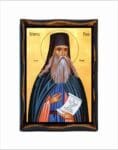

Paisius Velichkovsky
Our company offers wholesale sales for Monasteries, Exhibitions, Ecclesiastical Stores, Gift Shops, and Merchants. We provide competitive pricing based on the quantities you order, ensuring the best possible offer to meet your needs.
For more details on our products and to receive personalized offers, please contact us directly. We are happy to discuss terms and provide the best solutions tailored to you.
Paisie de la Neamţ – Païsij Velyčkovs’kyj – Paisie Velicicovschi – Païssy Velitchkovsky – Paisio Wieliczkowski
Dimensions: 11 x 8 cm – 4.33”x3.14”in , 15 x 11 cm – 5.9”x4.33”in , 21 x 15 cm – 8.3”x5.9”in , 27 x 21 cm – 10.6” X8.3”in – 42 x 32 cm – 16.5“x12.60”in
| Title | Range | Sale price |
|---|---|---|
| Total items | 5 - 10 | 12,87 £ |
| Total items | 11 - 30 | 11,51 £ |
| Total items | 31 - 60 | 10,16 £ |
| Total items | 61 - 150 | 8,81 £ |

Description
Paisius Velichkovsky or Wieliczkowski (Paisie de la Neamţ in Romanian; Паисий Величковский in Russian; Паїсій Величковський in Ukrainian; 20 December 1722 – 15 November 1794) was an Eastern Orthodox monk and theologian who helped spread staretsdom or the concept of the spiritual elder to the Slavic world. He is a pivotal figure in Orthodox Church history.
A Ukrainian by birth, Pyotr Velichkovsky was born on December 21, 1722, in Poltava, where his father, Ivan, was a priest in the city cathedral. He was the eleventh of twelve children. His grandfather was the poet Ivan Velichkovsky.
In 1735, he was sent to study at the Kiev Theological Academy. In 1741, he became a rasophore monk, taking the name of “Platon”. However, his monastery was soon closed, because of the political stresses during the time, and he entered the Pechersky Lavra at Kiev. Here he was influenced by the monk Ignatii, who told him about the hesychastic fervor he had found in Romanian monasteries. During the lent of 1743, Platon travelled to the monastic environments of the Dălhăuţi, the Trăisteni, and the Carnul Sketes. The first two Moldavian communities were under the spiritual eldership of Basil of Poiana Mărului, who became an important formative influence on Platon’s spiritual life, teaching him about the Prayer of the Heart. The third Skete was located in Wallachia. All of them followed the Athonite hesychast observances.
Additional Information
| Weight | N/A |
|---|---|
| Dimensions | 11cm x 8cm x 1.2cm, 15cm x 11cm x 1.7cm, 21cm x 15cm x 1.7cm, 27cm x 21cm x 1.7cm, 42cm x 32cm x 1.7cm |
There are no question found.
Related products


Phocas Gardener
Seller




Rating & Review
There are no reviews yet.