
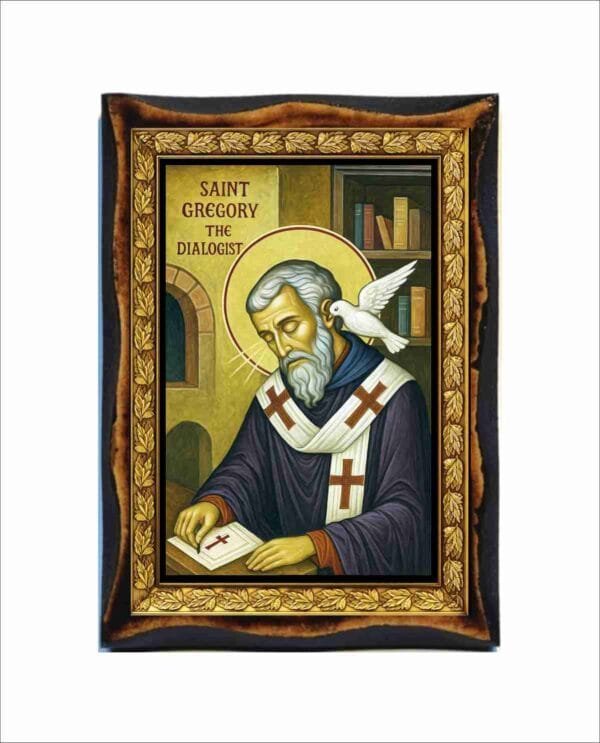


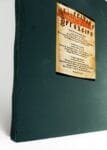
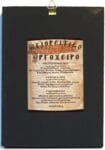
Pope Gregory I
Our company offers wholesale sales for Monasteries, Exhibitions, Ecclesiastical Stores, Gift Shops, and Merchants. We provide competitive pricing based on the quantities you order, ensuring the best possible offer to meet your needs.
For more details on our products and to receive personalized offers, please contact us directly. We are happy to discuss terms and provide the best solutions tailored to you.
Gregory the Dialogist – Gregory the Great – Papa Gregorio I – Grégoire le Grand – Grzegorz I – Gregor der Große – Gregorio I
Dimensions: 11 x 8 cm – 4.33”x3.14”in , 15 x 11 cm – 5.9”x4.33”in , 21 x 15 cm – 8.3”x5.9”in , 27 x 21 cm – 10.6” X8.3”in – 42 x 32 cm – 16.5“x12.60”in
| Title | Range | Sale price |
|---|---|---|
| Total items | 5 - 10 | 15,20 € |
| Total items | 11 - 30 | 13,60 € |
| Total items | 31 - 60 | 12,00 € |
| Total items | 61 - 150 | 10,40 € |

Description
Pope Gregory I (Latin: Gregorius I; c. 540 – 12 March 604), commonly known as Saint Gregory the Great, was the bishop of Rome from 3 September 590 to his death. He is known for instigating the first recorded large-scale mission from Rome, the Gregorian Mission, to convert the then-pagan Anglo-Saxons in England to Christianity. Gregory is also well known for his writings, which were more prolific than those of any of his predecessors as pope. The epithet Saint Gregory the Dialogist has been attached to him in Eastern Christianity because of his Dialogues. English translations of Eastern texts sometimes list him as Gregory “Dialogos”, or the Anglo-Latinate equivalent “Dialogus”.
A Roman senator’s son and himself the prefect of Rome at 30, Gregory tried living in a monastery but soon returned to active public life, ending his career and the century as pope. Although he was the first pope from a monastic background, his prior political experiences may have helped him to be a talented administrator. During his papacy, he greatly surpassed with his administration the emperors in improving the welfare of the people of Rome, and he challenged the theological views of Patriarch Eutychius of Constantinople before the emperor Tiberius II. Gregory regained papal authority in Spain and France and sent missionaries to England, including Augustine of Canterbury and Paulinus of York. The realignment of barbarian allegiance to Rome from their Arian Christian alliances shaped medieval Europe. Gregory saw Franks, Lombards, and Visigoths align with Rome in religion. He also combated the Donatist heresy, popular particularly in North Africa at the time.
Throughout the Middle Ages, he was known as “the Father of Christian Worship” because of his exceptional efforts in revising the Roman worship of his day. His contributions to the development of the Divine Liturgy of the Presanctified Gifts, still in use in the Byzantine Rite, were so significant that he is generally recognized as its de facto author.
Gregory is a Doctor of the Church and one of the Latin Fathers. He is considered a saint in the Catholic Church, Eastern Orthodox Church, Anglican Communion, and various Lutheran denominations and other Protestant denominations. Immediately after his death, Gregory was canonized by popular acclaim. The Protestant reformer John Calvin admired Gregory greatly, and declared in his Institutes that Gregory was the last good Pope. He is the patron saint of musicians, singers, students, and teachers.
On his father’s death, Gregory converted his family villa into a monastery dedicated to Andrew the Apostle (after his death it was rededicated as San Gregorio Magno al Celio). In his life of contemplation, Gregory concluded that “in that silence of the heart, while we keep watch within through contemplation, we are as if asleep to all things that are without.”.
Gregory had a deep respect for the monastic life and particularly the vow of poverty. Thus, when it came to light that a monk lying on his death bed had stolen three gold pieces, Gregory, as a remedial punishment, forced the monk to die alone, then threw his body and coins on a manure heap to rot with a condemnation, “Take your money with you to perdition.” Gregory believed that punishment of sins can begin, even in this life before death. However, in time, after the monk’s death, Gregory had 30 Masses offered for the man to assist his soul before the final judgment. He viewed being a monk as the ‘ardent quest for the vision of our Creator. His three paternal aunts were nuns renowned for their sanctity. However, after the eldest two, Trasilla and Emiliana, died after seeing a vision of their ancestor Pope Felix III, the youngest soon abandoned the religious life and married the steward of her estate. Gregory’s response to this family scandal was that “many are called but few are chosen.” Gregory’s mother Silvia herself is a saint.
Eventually, Pope Pelagius II ordained Gregory a deacon and solicited his help in trying to heal the schism of the Three Chapters in northern Italy. However, this schism was not healed until well after Gregory was gone.
Additional Information
| Weight | N/A |
|---|---|
| Dimensions | 11cm x 8cm x 1.2cm, 15cm x 11cm x 1.7cm, 21cm x 15cm x 1.7cm, 27cm x 21cm x 1.7cm, 42cm x 32cm x 1.7cm |
There are no question found.




Rating & Review
There are no reviews yet.