


Brigid of Kildare
Our company offers wholesale sales for Monasteries, Exhibitions, Ecclesiastical Stores, Gift Shops, and Merchants. We provide competitive pricing based on the quantities you order, ensuring the best possible offer to meet your needs.
For more details on our products and to receive personalized offers, please contact us directly. We are happy to discuss terms and provide the best solutions tailored to you.
Brigid of Ireland – Brigida di Kildare – Sainte Brigitte – Santa Brigida – Brígida de Kildare – Brigida von Kildare
Dimensions: 11 x 8 cm – 4.33”x3.14”in , 15 x 11 cm – 5.9”x4.33”in , 21 x 15 cm – 8.3”x5.9”in , 27 x 21 cm – 10.6” X8.3”in – 42 x 32 cm – 16.5“x12.60”in
| Title | Range | Sale price |
|---|---|---|
| Total items | 5 - 10 | 15,20 € |
| Total items | 11 - 30 | 13,60 € |
| Total items | 31 - 60 | 12,00 € |
| Total items | 61 - 150 | 10,40 € |

Description
This Icon is a copy of the Hagiography (Holy Card Printing) that we have made in our Laboratory and we reserve the exclusive rights to reproduce these images, which are protected by copyright.
Saint Brigid of Kildare or Brigid of Ireland (Irish: Naomh Bríd; Latin: Brigida; c. 451 – 525) is one of Ireland’s patron saints, along with Patrick and Columba. Irish hagiography makes her an early Irish Christian nun, abbess, and foundress of several monasteries of nuns, including that of Kildare in Ireland, which was famous and was revered. Her feast day is 1 February, which was originally a pagan festival called Imbolc, marking the beginning of spring. Her feast day is shared by Dar Lugdach, who tradition says was her student, close companion, and the woman who succeeded her.
The saint shares her name with an important Celtic goddess and there are many legends and folk customs associated with her.
The saint has the same name as the goddess Brigid, derived from the Proto-Celtic *Brigantī “high, exalted” and ultimately originating with Proto-Indo-European *bʰerǵʰ-. In Old Irish her name was spelled Brigit and pronounced [ˈbʲrʲiɣʲidʲ]. In Modern Irish she is called Bríd. In Welsh she is called Ffraid (lenited to Fraid), as in several places called Llansanffraid, “St Brigit’s church”). She is sometimes referred to as “the Mary of the Gael”.
According to tradition, Brigid was born in the year 451 AD in Faughart, just north of Dundalk in County Louth, Ireland. Because of the legendary quality of the earliest accounts of her life, there is debate among many secular scholars and Christians as to the authenticity of her biographies. Three biographies agree that her mother was Brocca, a Christian Pict slave who had been baptized by Saint Patrick. They name her father as Dubhthach, a chieftain of Leinster.
The vitae say that Dubthach’s wife forced him to sell Brigid’s mother to a druid when she became pregnant. Brigid herself was born into slavery. Legends of her early holiness include her vomiting when the druid tried to feed her, due to his impurity; a white cow with red ears appeared to sustain her instead.
As she grew older, Brigid performed miracles, including healing and feeding the poor. According to one tale, as a child, she once gave away her mother’s entire store of butter. The butter was then replenished in answer to Brigid’s prayers. Around the age of ten, she was returned as a household servant to her father, where her habit of charity led her to donate his belongings to anyone who asked.
In two Lives, Dubthach was so annoyed with her that he took her in a chariot to the King of Leinster to sell her. While Dubthach was talking to the king, Brigid gave away his jewelled sword to a beggar to barter it for food to feed his family. The king recognized her holiness and convinced Dubthach to grant his daughter her freedom.
Additional Information
| Weight | N/A |
|---|---|
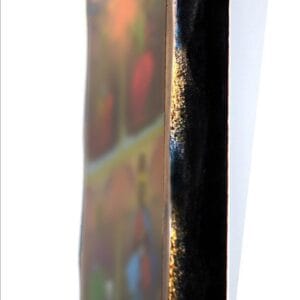
| Dimensions | 11cm x 8cm x 1.2, 15cmx 11cm x 1.7, 21cm x 15cm x 1.7, 27cm x 21cm x 1.7, 42cm x 32cm x 1.7 |
There are no question found.





Rating & Review
There are no reviews yet.