


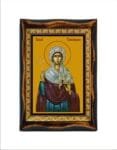


Saint Constance
Our company offers wholesale sales for Monasteries, Exhibitions, Ecclesiastical Stores, Gift Shops, and Merchants. We provide competitive pricing based on the quantities you order, ensuring the best possible offer to meet your needs.
For more details on our products and to receive personalized offers, please contact us directly. We are happy to discuss terms and provide the best solutions tailored to you.
Santa Costantina – Santa Costanza – Sainte Constance – Constanza de Roma – Constantina – Konstantyna – Santa Constança
Dimensions: 11 x 8 cm – 4.33”x3.14”in , 15 x 11 cm – 5.9”x4.33”in , 21 x 15 cm – 8.3”x5.9”in , 27 x 21 cm – 10.6” X8.3”in – 42 x 32 cm – 16.5“x12.60”in
| Title | Range | Sale price |
|---|---|---|
| Total items | 5 - 10 | 15,20 € |
| Total items | 11 - 30 | 13,60 € |
| Total items | 31 - 60 | 12,00 € |
| Total items | 61 - 150 | 10,40 € |

Description
Flavia Valeria Constantina[a] (also sometimes called Constantia and Constantiana; Greek: Κωνσταντίνα; b. after 307/before 317 – d. 354), later known as Saint Constance, was the eldest daughter of Roman emperor Constantine the Great and his second wife Fausta, daughter of Emperor Maximian. Constantina may have received the title of Augusta by her father, and is venerated as a saint, having developed a medieval legend wildly at variance with what is known of her actual character.
Sarcophagus of Constantina, sculpted around AD 340. Formerly in the Mausoleo di Santa Costanza, part of the complex of Sant’Agnese fuori le mura in Rome, it is now on display at the Museo Pio-Clementino in the Vatican City.
Some time before mid 320s, Constantina was born to the emperor Constantine and empress Fausta. She was sister to Constantine II, Constans, Constantius II, Helena and half-sister to Crispus. In 335, Constantina married her cousin Hannibalianus, son of Flavius Dalmatius, whom Constantine I had created Rex Regum et Ponticarum Gentium, “King of Kings and Ruler of the Pontic Tribes”. From her first marriage, Constantina may had a daughter, Constantia, who later married Memmius Vitrasius Orfitus and become mother of Rusticiana, wife of Quintus Aurelius Symmachus.[3] After Constantine died, great purges of the imperial family occurred and her husband was executed in 337.
For the second time, Constantius II gave Constantina to Hannibalianus’ cousin, and her own half cousin Gallus. Gallus was created a Caesar of the East and his name changed to Constantius Gallus to further his legitimacy around 349/350, which also presumably was the time of their marriage. Gallus was twenty-five or twenty-six at the time, whereas Constantina was substantially his senior. Her second marriage produced a daughter Anastasia, whose full name and fate are unknown.
Constantina and Constantius Gallus were then sent from Rome to Syria at Antioch to govern that portion of the Eastern Roman Empire. She would not return to Rome until her death. In AD 354, when Constantius called for Gallus, the caesar sent Constantina to her brother, with the purpose to mitigate his position in Constantius’ consideration. While on her way to meet with Constantius II, she died at Caeni Gallicani in Bithynia (Asia Minor). The cause of her death was a sudden high fever of unknown cause. Her body was sent back to Rome and entombed near Via Nomentana in a mausoleum her father, Emperor Constantine I, had started building for her. This mausoleum would later become known as the church of Santa Costanza, when Constantina was venerated as saint. Her porphyry sarcophagus is on exhibit in the Vatican Museums
Additional Information
| Weight | N/A |
|---|---|
| Dimensions | 11cm x 8cm x 1.2cm, 15cm x 11cm x 1.7cm, 21cm x 15cm x 1.7cm, 27cm x 21cm x 1.7cm, 42cm x 32cm x 1.7cm |
There are no question found.






Rating & Review
There are no reviews yet.