
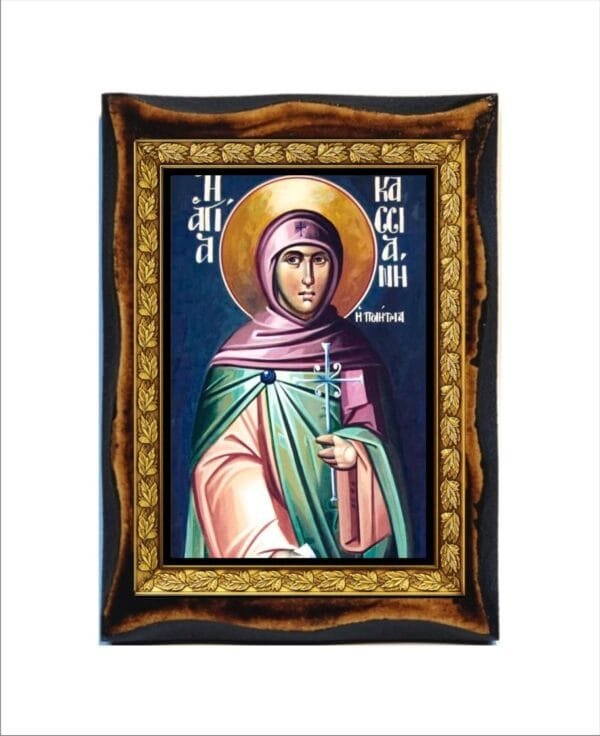
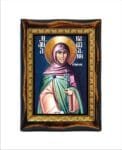


Saint Kassiani
Our company offers wholesale sales for Monasteries, Exhibitions, Ecclesiastical Stores, Gift Shops, and Merchants. We provide competitive pricing based on the quantities you order, ensuring the best possible offer to meet your needs.
For more details on our products and to receive personalized offers, please contact us directly. We are happy to discuss terms and provide the best solutions tailored to you.
San Cassiani – Santa Kassiani – Sfântul Kassiani – Святой Кассиани – Święty Kassiani
Dimensions: 11 x 8 cm – 4.33”x3.14”in , 15 x 11 cm – 5.9”x4.33”in , 21 x 15 cm – 8.3”x5.9”in , 27 x 21 cm – 10.6” X8.3”in – 42 x 32 cm – 16.5“x12.60”in
| Title | Range | Sale price |
|---|---|---|
| Total items | 5 - 10 | 15,20 € |
| Total items | 11 - 30 | 13,60 € |
| Total items | 31 - 60 | 12,00 € |
| Total items | 61 - 150 | 10,40 € |

Description
Osia Kassiani (or Cassia or Ikasia or Ikasia) the Hymnographer was born between 805 and 810 AD. in Constantinople and lived in the years of King Theophilos (829-842 AD).
When she grew up she combined her physical beauty with her intelligence. Three Byzantine chroniclers, Simeon the translator (see November 9), George Amartolos and Leo the Grammaticus, report that she took part in the bride-selection ceremony for the emperor Theophilus,which had been organized by his stepmother Euphrosyne. In this the emperor chose the wife of his choice by giving her a golden apple. Dazzled by Cassia’s beauty, the young emperor approached her and said: “Thus through women came evils” “From a woman evil [things] came into the world”, referring to the sin and calamities that arose from Eve .Cassia, ready to speak, answered him: “But through a woman also comes the cretins” “And from a woman [came into the world] good [things]”, referring to the hope of salvation from the incarnation of Christ through the Virgin Mary.
Theophilus’ ego was wounded and he rejected Cassiani and chose Theodora as his wife.
The next surviving information about Kassiani is that in 843 AD. founded a convent in the west of Constantinople, near the city walls, of which she became the first abbess. Although many researchers attribute her choice to her failure to become empress,a letter of Theodore the Studite attributes different motives to her action. It maintained a close relationship with the neighboring Monastery of Studi, which was to play an important role in the reprinting of Byzantine liturgical books in the 9th and 10th centuries AD, resulting in the preservation of its works.
According to tradition, the emperor Theophilos, still in love with her, wished to see her one last time before he died, so he went to the monastery where she was. Cassiani was alone in her cell writing her well-known tropa, which is sung in the Churches on the evening of Holy Tuesday, when she perceived the arrival of the imperial retinue.She still loved him but had now dedicated her life to God for this and hid herself, not wishing to let her old passion overcome her monastic zeal. But he left the half-finished hymn on a table. Theofilos discovered her cell and entered it alone. He looked for her but in vain. She was watching him from a closet in which she had hidden.Theophilos was saddened, cried and regretted that for a moment of pride he lost such a beautiful and intelligent woman. Then he found Cassian’s manuscripts on the table and read them. As soon as he finished reading he sat down and added a verse to the hymn. According to the tradition, this verse was “where in paradise Eὔ τὸ διλινόν, cry to those whom I asked, I hid myself in fear”.Leaving, he spotted Cassiani hiding in the closet but did not speak to her, respecting her wish. Cassiani emerged from her hiding place after the emperor’s departure, read his addendum, and then finished the hymn.
This great poet, hymn writer and melodist of our church, Saint Kassiani, traveled to Italy and Crete and ended up in Kasos where her earthly life ended. After her death, they placed her body in a marble urn and placed her in a chapel, which was dedicated to her name.The larnaca and the Byzantine mosaic of the 9th century AD are preserved today. Also in the chapel there is a built-in plaque with the sign of the cross and the date 890 AD. According to information, again from Kassos, the bones of Ossia have been transferred to Ikaria.
Although her memory is not mentioned by any Synaxarist, the Cassios, due to the affinity of her name with their island, established her memory on September 7, and George Sassos Kassios also advocated a special Order, which was published in Alexandria in 1889. .X. at the “Reform” printing office.The paradox, however, is that this Order was dedicated to the Patriarch of Alexandria, Sophronius, who then gave it to Metropolitan Germanos of Thebes for printing (on September 1, 1889 AD) and thus, in a way, the canonization of Kassiani was formalized by the Church of Alexandria, as the residents of Kasos desired.
The presence of Kassiani has overshadowed the hymn writers and melodists of her time, because she is the most prominent female melodist (she wrote both the hymns and the melody) in the history of Byzantine music.Having special talent, intelligence, sensitivity and expressive wealth, she distinguished herself in the field of music (this was helped by the great education, which her noble origin allowed her to have). That is why her work is timeless and always relevant, and it particularly moves the Orthodox world.
Her memory is honored on September 7.
Additional Information
| Weight | N/A |
|---|---|
| Dimensions | 11cm x 8cm x 1.2, 15cmx 11cm x 1.7, 21cm x 15cm x 1.7, 27cm x 21cm x 1.7, 42cm x 32cm x 1.7 |
There are no question found.
Related products

Hezekiah King Judah
Seller


Rating & Review
There are no reviews yet.