







Saint Nicholas
Our company offers wholesale sales for Monasteries, Exhibitions, Ecclesiastical Stores, Gift Shops, and Merchants. We provide competitive pricing based on the quantities you order, ensuring the best possible offer to meet your needs.
For more details on our products and to receive personalized offers, please contact us directly. We are happy to discuss terms and provide the best solutions tailored to you.
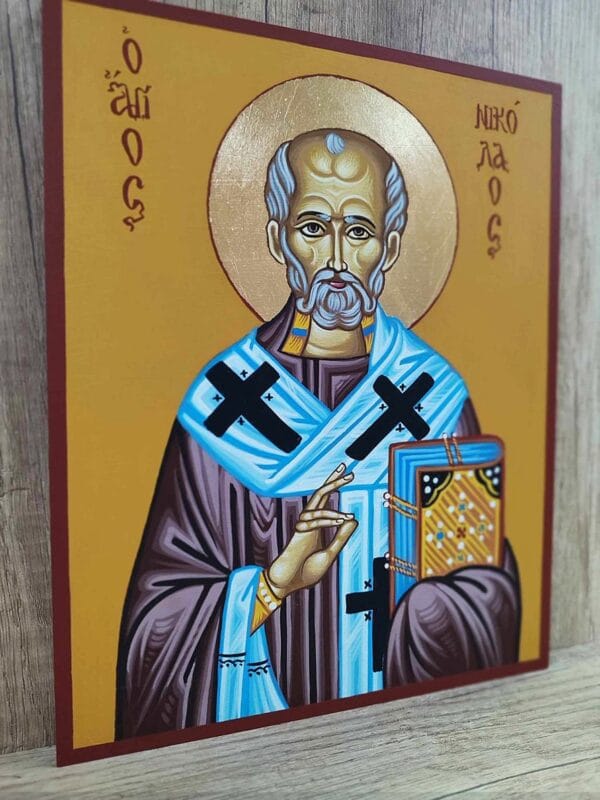
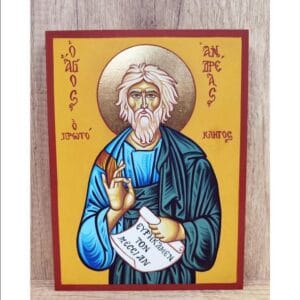
Nicholas of Myra – Nicholas of Bari – San Nicola di Bari – Nicolas de Myre – Handmade and Hand Painted Original Icon
30cm x 24cm x 1.7 – 11.811 ” x 9.45″ x 0.7″ inches

Description
Handmade and Hand Painted Icon
This icon is a work of Christian art and is a Holy religious item blessed from Christian Church.
Is entirely hand painted on a piece of wood the dimensions are 30cm x 24cm x 1.7 – 11.811 ” x 9.45″ x 0.7″ inches and the materials used for painting are eggtempera and gold leaf 24k.
The Icons have a 24k gold leaf in the halos and the ocher background colour is with egg tempera.
Every Holy Icon takes to complete 10 to 15 days depending on the size and type of the background.
The HolySpiritArt retains sole rights to reproduce these images, all of which are copyrighted.
Saint Nicholas of Myra[a] (traditionally 15 March 270 – 6 December 343),also known as Nicholas of Bari, was an early Christian bishop of Greek descent from the maritime city of Myra in Asia Minor (Greek: Μύρα; modern-day Demre, Turkey) during the time of the Roman Empire. Because of the many miracles attributed to his intercession, he is also known as Nicholas the Wonderworker.[c] Saint Nicholas is the patron saint of sailors, merchants, archers, repentant thieves, children, brewers, pawnbrokers, unmarried people, and students in various cities and countries around Europe. His reputation evolved among the pious, as was common for early Christian saints, and his legendary habit of secret gift-giving gave rise to the traditional model of Santa Claus (“Saint Nick”) through Sinterklaas.
Very little is known about the historical Saint Nicholas. The earliest accounts of his life were written centuries after his death and contain many legendary elaborations. He is said to have been born in the Greek seaport of Patara, Lycia in Asia Minor to wealthy Christian parents. In one of the earliest attested and most famous incidents from his life, he is said to have rescued three girls from being forced into prostitution by dropping a sack of gold coins through the window of their house each night for three nights so their father could pay a dowry for each of them. Other early stories tell of him calming a storm at sea, saving three innocent soldiers from wrongful execution, and chopping down a tree possessed by a demon. In his youth, he is said to have made a pilgrimage to Egypt and Palestine. Shortly after his return, he became Bishop of Myra. He was later cast into prison during the persecution of Diocletian, but was released after the accession of Constantine. An early list makes him an attendee at the First Council of Nicaea in 325, but he is never mentioned in any writings by people who were at the council. Late, unsubstantiated legends claim that he was temporarily defrocked and imprisoned during the council for slapping the heretic Arius. Another famous late legend tells how he resurrected three children, who had been murdered and pickled in brine by a butcher planning to sell them as pork during a famine.
Fewer than 200 years after Nicholas’s death, the St. Nicholas Church was built in Myra under the orders of Theodosius II over the site of the church where he had served as bishop, and his remains were moved to a sarcophagus in that church. In 1087, while the Greek Christian inhabitants of the region were subjugated by the newly arrived Muslim Seljuk Turks, and soon after their church was declared to be in schism by the Catholic church, a group of merchants from the Italian city of Bari removed the major bones of Nicholas’s skeleton from his sarcophagus in the church without authorization and brought them to their hometown, where they are now enshrined in the Basilica di San Nicola. The remaining bone fragments from the sarcophagus were later removed by Venetian sailors and taken to Venice during the First Crusade.
Additional Information
| Weight | 1 kg |
|---|
There are no question found.




Rating & Review
There are no reviews yet.