
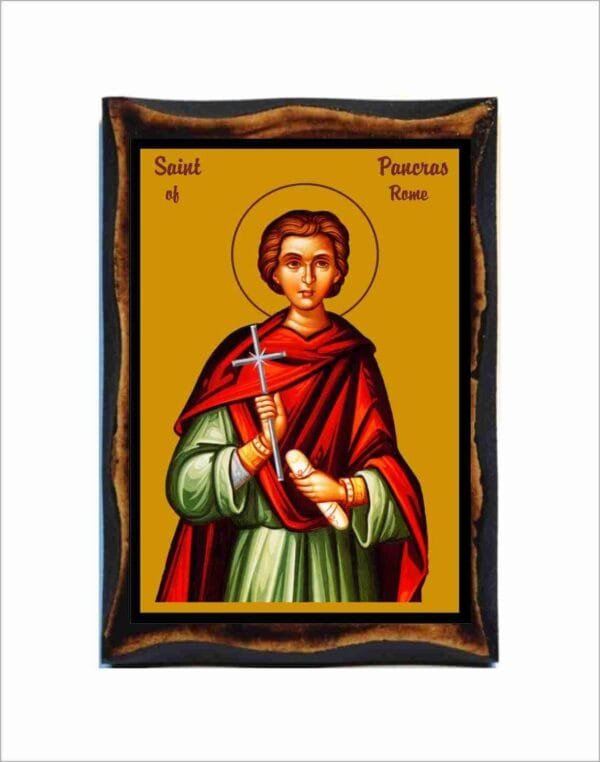
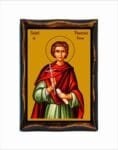

Saint Pancras
Our company offers wholesale sales for Monasteries, Exhibitions, Ecclesiastical Stores, Gift Shops, and Merchants. We provide competitive pricing based on the quantities you order, ensuring the best possible offer to meet your needs.
For more details on our products and to receive personalized offers, please contact us directly. We are happy to discuss terms and provide the best solutions tailored to you.
San Pancrazio – Pankratios – Pancrace de Rome – San Pancracio – Sfântul Pancrațiu -Pankratius – Pancras – Pancraas – Pankrác
Dimensions: 11 x 8 cm – 4.33”x3.14”in , 15 x 11 cm – 5.9”x4.33”in , 21 x 15 cm – 8.3”x5.9”in , 27 x 21 cm – 10.6” X8.3”in – 42 x 32 cm – 16.5“x12.60”in
| Title | Range | Sale price |
|---|---|---|
| Total items | 5 - 10 | 15,20 € |
| Total items | 11 - 30 | 13,60 € |
| Total items | 31 - 60 | 12,00 € |
| Total items | 61 - 150 | 10,40 € |

Description
Pancras (Latin: Sanctus Pancratius) was a Roman citizen who converted to Christianity and was beheaded for his faith at the age of fourteen, around the year 304. His name is Greek (Πανκράτιος Pankrátios), meaning ‘all-powerful’.
From an early period, Pancras was venerated together with Nereus and Achilleus in a shared feast day and Mass formula on 12 May. In 1595, 25 years after Pope Pius V promulgated the Tridentine Missal, Domitilla was also added.
Since 1969, Pancras has been venerated separately, still on 12 May. He is traditionally the second of the Ice Saints. In the Syriac traditions he is known as Mor Izozoel (Mar Azazael), remembered on 12 May and 12 August. He is the patron saint of children.
The London district of St Pancras, and by extension, the railway station of the same name, is named after St Pancras Old Church and St Pancras New Church.
Because he was said to have been martyred at the age of fourteen during the persecution under Diocletian, Pancras would have been born around 289, at a place designated as near Synnada, a city of Phrygia Salutaris, to parents of Roman citizenship. When Pancras was nine years old, his mother Cyriada died during childbirth; his father died of grief not long after. Pancras was entrusted to his uncle Dionysius’ care. They both moved to Rome to live in a villa on the Caelian Hill. They were converted to Christianity by one Marcellinus, and Pancras became a zealous adherent of the religion. Dionysius subsequently died, leaving Pancras on his own.
During the persecution of Christians by Emperor Diocletian, around 303 AD, he was brought before the authorities and asked to perform a sacrifice to the Roman gods. Diocletian, impressed with the boy’s determination to resist, promised him wealth and power, but Pancras refused, and finally the emperor ordered him to be beheaded on the Via Aurelia, on 12 May 303 AD. This traditional year of his martyrdom cannot be squared with the saint’s defiance of Diocletian in Rome, which the emperor had not visited since 286, nor with the mention of Cornelius (251–253) as Bishop of Rome at the time of the martyrdom, as the most recent monograph on Pancras’ texts and cult has pointed out.
A Roman matron named Octavilla recovered Pancras’ body, covered it with balsam, wrapped it in precious linens, and buried it in a newly built sepulchre dug in the Catacombs of Rome. Pancras’ head was placed in the reliquary that still exists today in the Basilica of Saint Pancras.
Additional Information
| Weight | N/A |
|---|---|
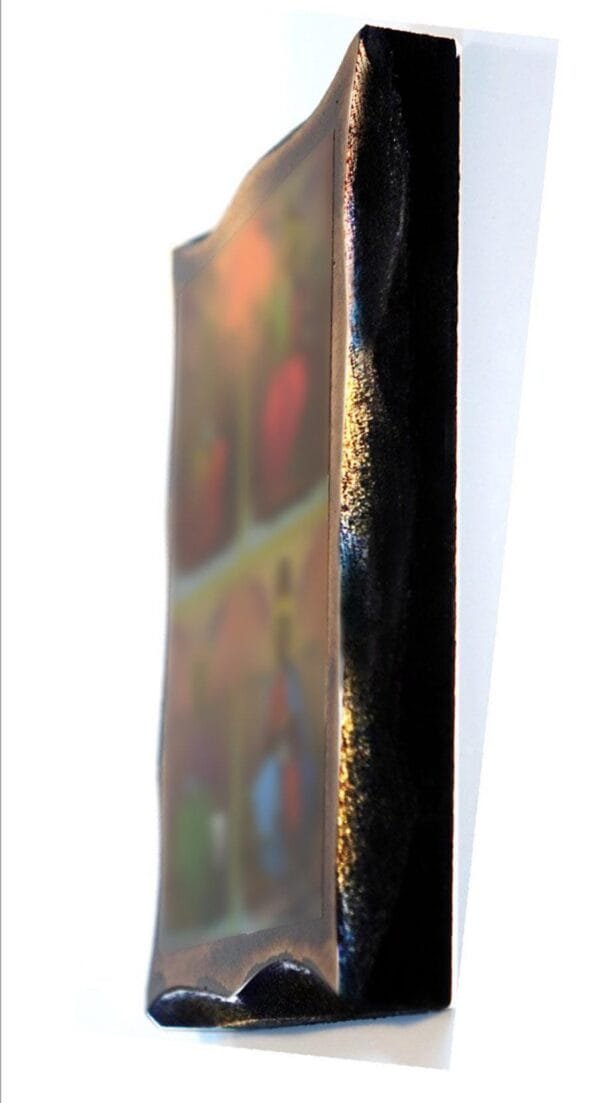
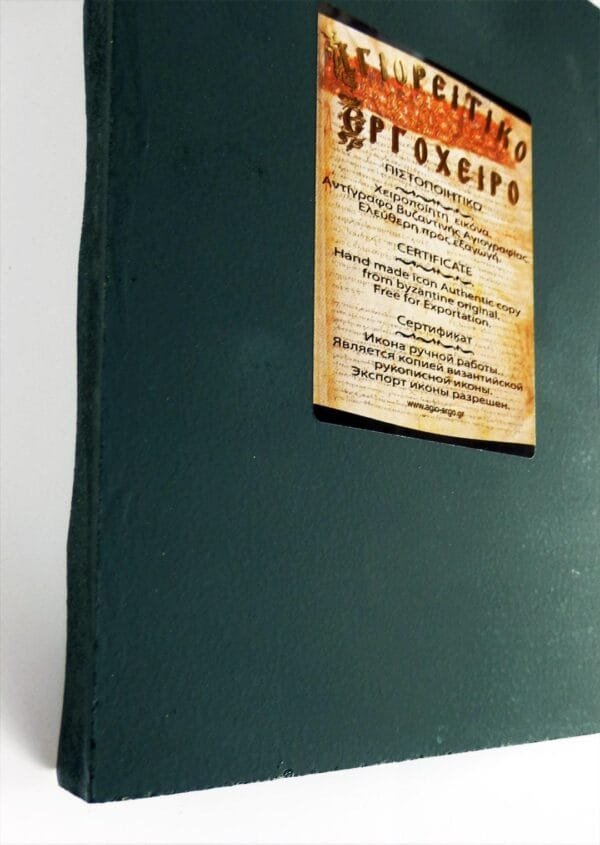
| Dimensions | 11cm x 8cm x 1.2cm, 15cm x 11cm x 1.7cm, 21cm x 15cm x 1.7cm, 27cm x 21cm x 1.7cm, 42cm x 32cm x 1.7cm |
There are no question found.







Rating & Review
There are no reviews yet.