
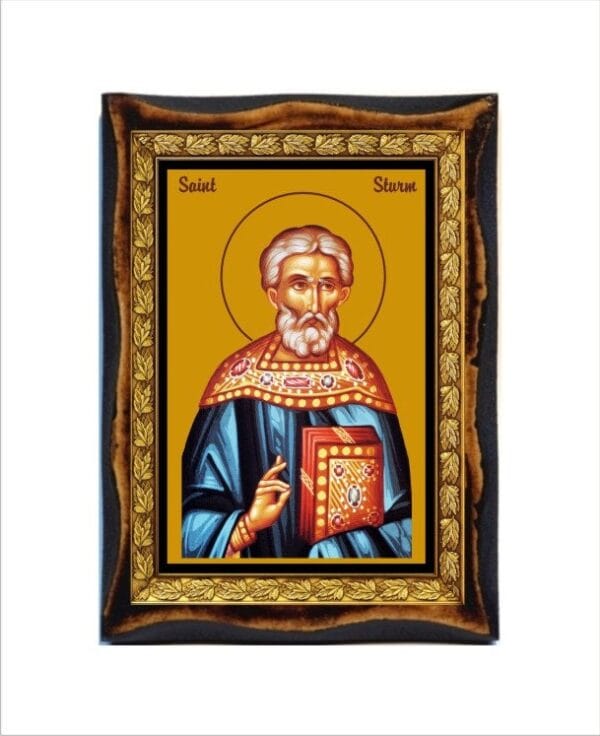


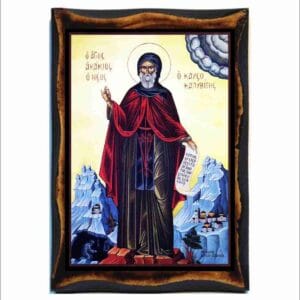
Saint Sturm
Our company offers wholesale sales for Monasteries, Exhibitions, Ecclesiastical Stores, Gift Shops, and Merchants. We provide competitive pricing based on the quantities you order, ensuring the best possible offer to meet your needs.
For more details on our products and to receive personalized offers, please contact us directly. We are happy to discuss terms and provide the best solutions tailored to you.
Abbot Sturm of Fulda – Sturmio di Fulda – Santo Sturmio – Sturm de Fulda – Sturmiusz z Fuldy – San Esturmio – Sturm
Dimensions: 11 x 8 cm – 4.33”x3.14”in , 15 x 11 cm – 5.9”x4.33”in , 21 x 15 cm – 8.3”x5.9”in , 27 x 21 cm – 10.6” X8.3”in – 42 x 32 cm – 16.5“x12.60”in
| Title | Range | Sale price |
|---|---|---|
| Total items | 5 - 10 | 15,20 € |
| Total items | 11 - 30 | 13,60 € |
| Total items | 31 - 60 | 12,00 € |
| Total items | 61 - 150 | 10,40 € |

Description
Sturm (c. 705 – 17 December 779), also called Sturmius or Sturmi, was a disciple of Boniface and founder and first abbot of the Benedictine monastery and abbey of Fulda in 742 or 744. Sturm’s tenure as abbot lasted from 747 until 779.
Life
Sturm was born c. 705 in Lorch, Austria, and was most likely related to the Agilolfing dukes of Bavaria. His parents placed him under the care of Boniface, who was carrying out the church reorganization in Bavaria and Austria (founding the bishoprics of Salzburg, Regensburg and Würzburg). He was educated in the Benedictine monastery of Fritzlar by abbot Wigbert.
He was then active as a missionary in northern Hesse, where in 736 he established a monastic settlement in Haerulfisfeld (Hersfeld). Ordained in 740 as priest in Fritzlar. Boniface sent him to work for three years as a missionary in Westphalia. He then was a hermit at Hersfeld, until raiding Saxons drove him from his unprotected hermitage.
Sturm was instructed by Boniface in 744 to establish a monastery in the region of Eichloha, which had been granted to Boniface by the Frankish Mayor of the Palace Carloman. In the ruins of a 6th-century Merovingian royal camp, destroyed 50 years earlier by the Saxons, at a ford on the Fulda River, Sturm established the monastery and was named first abbot of Fulda by Boniface.
Around 748, Sturm and two other monks went to study Benedictine life as practiced at Monte Cassino and establish it at Fulda. They spent a year visiting Benedictine abbeys learning how the monks lived. Before returning to Fulda, Sturm met with Pope Zachary, who placed the monastery under the jurisdiction of the Vatican, rather than under the bishop. After the death of Boniface, this led to serious conflicts between Lullus, then archbishop of Mainz, and abbot Sturm. Nevertheless, Sturm prevailed over the bishops of Mainz and Utrecht in having Boniface, so-called Apostle of the Germans, buried in Fulda after his assassination in 754 near Dokkum in Frisia. This made Fulda a major place of pilgrimage for many peoples, including Anglo-Saxons, and brought much prestige and a stream of gifts and donations to Fulda.
Additional Information
| Weight | N/A |
|---|---|
| Dimensions | 11cm x 8cm x 1.2cm, 15cm x 11cm x 1.7cm, 21cm x 15cm x 1.7cm, 27cm x 21cm x 1.7cm, 42cm x 32cm x 1.7cm |
There are no question found.




Rating & Review
There are no reviews yet.