


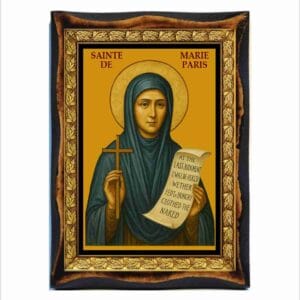
Saint Ursula
Our company offers wholesale sales for Monasteries, Exhibitions, Ecclesiastical Stores, Gift Shops, and Merchants. We provide competitive pricing based on the quantities you order, ensuring the best possible offer to meet your needs.
For more details on our products and to receive personalized offers, please contact us directly. We are happy to discuss terms and provide the best solutions tailored to you.
Sainte Ursule – Santa Ursula – Sankta Ursulo de Kolonjo – Santa Orsola – Úrsula de Colònia – Святая Урсула – Santa Urtsula
Dimensions: 11 x 8 cm – 4.33”x3.14”in , 15 x 11 cm – 5.9”x4.33”in , 21 x 15 cm – 8.3”x5.9”in , 27 x 21 cm – 10.6” X8.3”in – 42 x 32 cm – 16.5“x12.60”in
| Title | Range | Sale price |
|---|---|---|
| Total items | 5 - 10 | 15,20 € |
| Total items | 11 - 30 | 13,60 € |
| Total items | 31 - 60 | 12,00 € |
| Total items | 61 - 150 | 10,40 € |

Description
Saint Ursula (Latin for ‘little female bear’) is a Romano-British Christian saint, died on October 21, 383. Her feast day in the pre-1970 General Roman Calendar is October 21. There is little definite information about her and the anonymous group of holy virgins who accompanied her and on some uncertain date were killed at Cologne. They remain in the Roman Martyrology, although their commemoration does not appear in the simplified Calendarium Romanum Generale (General Roman Calendar) of the 1970 Missale Romanum.
The earliest evidence of her is a 4th- or 5th-century inscription from the Church of St. Ursula, located on Ursulaplatz in Cologne which states that the ancient basilica had been restored on the site where some holy virgins were killed.
Her legendary status comes from a medieval story that she was a princess who, at the request of her father King Dionotus of Dumnonia in south-west Britain, set sail along with 11,000 virginal handmaidens to join her future husband, the pagan governor Conan Meriadoc of Armorica. After a miraculous storm brought them over the sea in a single day to a Gaulish port, Ursula declared that before her marriage she would undertake a pan-European pilgrimage. She headed for Rome with her followers and persuaded the Pope, Cyriacus (unknown in the pontifical records, though from late 384 AD there was a Pope Siricius), and Sulpicius, bishop of Ravenna, to join them. After setting out for Cologne, which was being besieged by Huns, all the virgins were beheaded in a massacre. The Huns’ leader fatally shot Ursula with a bow and arrow in about 383 AD (the date varies).
Additional Information
| Weight | N/A |
|---|---|
| Dimensions | 11cm x 8cm x 1.2cm, 15cm x 11cm x 1.7cm, 21cm x 15cm x 1.7cm, 27cm x 21cm x 1.7cm, 42cm x 32cm x 1.7cm |
There are no question found.







Rating & Review
There are no reviews yet.