
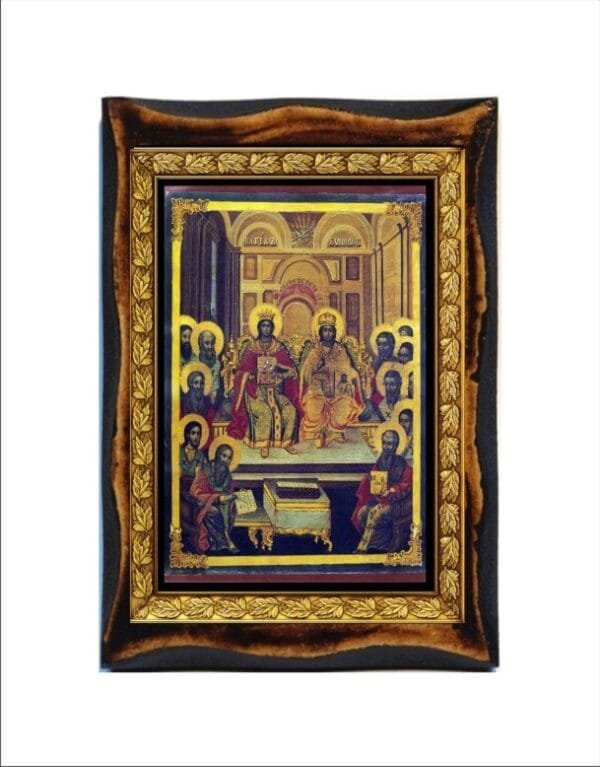
Seventh Ecumenical Council
Our company offers wholesale sales for Monasteries, Exhibitions, Ecclesiastical Stores, Gift Shops, and Merchants. We provide competitive pricing based on the quantities you order, ensuring the best possible offer to meet your needs.
For more details on our products and to receive personalized offers, please contact us directly. We are happy to discuss terms and provide the best solutions tailored to you.
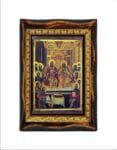
Seventh Ecumenical Council – Second Council of Nicaea – 7e Concile œcuménique – Concile de Nicée II
Dimensions: 11 x 8 cm – 4.33”x3.14”in , 15 x 11 cm – 5.9”x4.33”in , 21 x 15 cm – 8.3”x5.9”in , 27 x 21 cm – 10.6” X8.3”in – 42 x 32 cm – 16.5“x12.60”in
| Title | Range | Sale price |
|---|---|---|
| Total items | 5 - 10 | 15,20 € |
| Total items | 11 - 30 | 13,60 € |
| Total items | 31 - 60 | 12,00 € |
| Total items | 61 - 150 | 10,40 € |

Description
The Seventh Ecumenical Council took place in Nicea in 787 AD, and is also known as the Second Council of Nicaea. The last of the seven Ecumenical Councils dealt with the icons.
Disputes concerning the Person of Christ did not end with the sixth Council in AD 681, but continued through the eighth and ninth centuries. This time, the controversy focused on icons—pictures of Christ, the Theotokos, the saints, and holy events—and lasted for 120 years, starting in AD 726. Icons were kept and venerated in both churches and private homes. The two groups in the controversy were:
Iconoclasts
also called “icon-smashers,” they were suspicious of any art depicting God or humans; they demanded the destruction of icons because they saw icons as idolatry.
Iconodules
also called “venerators of icons,” they defended the place of icons in the Church.
The controversy, however, was more than a struggle over different views of Christian art. Deeper issues were involved, and it is these the Council addressed:
The character of Christ’s human nature
The Christian attitude toward matter
The true meaning of Christian redemption and the salvation of the entire material universe
The controversy falls into two periods:
From AD 726 when Leo III began his attack on icons until AD 780 when Empress Irene ended the attacks
Again from AD 815 through AD 843 when Empress Theodora stamped out the attacks permanently
The iconoclasts had support from both inside and outside the Church. Outside the Church, there may have been influence from Jewish and Muslim ideas, and it is important to note that just prior to the iconoclast outbreak Muslim Caliph Yezid ordered the removal of all icons with his territory. Inside the Church there had always existed a “puritan” outlook which saw all images as latent idolatry.
Largely through the work of St. John of Damascus (c. 676-749), who, ironically, was housed in Muslim-controlled lands and therefore outside the reach of the Empire, the iconodules’ position won out. He addressed the charges of the iconoclasts thus:
Concerning the charge of idolatry: Icons are not idols but symbols, therefore when an Orthodox venerates an icon, he is not guilty of idolatry. He is not worshipping the symbol, but merely venerating it. Such veneration is not directed toward wood, or paint or stone, but towards the person depicted. Therefore relative honor is shown to material objects, but worship is due to God alone.
We do not make obeisance to the nature of wood, but we revere and do obeisance to Him who was crucified on the Cross… When the two beams of the Cross are joined together I adore the figure because of Christ who was crucified on the Cross, but if the beams are separated, I throw them away and burn them. —St. John of Damascus
Additional Information
| Weight | N/A |
|---|---|
| Dimensions | 11cm x 8cm x 1.2cm, 15cm x 11cm x 1.7cm, 21cm x 15cm x 1.7cm, 27cm x 21cm x 1.7cm, 42cm x 32cm x 1.7cm |
There are no question found.




Rating & Review
There are no reviews yet.