



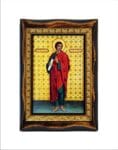


Thomas the Apostle
Our company offers wholesale sales for Monasteries, Exhibitions, Ecclesiastical Stores, Gift Shops, and Merchants. We provide competitive pricing based on the quantities you order, ensuring the best possible offer to meet your needs.
For more details on our products and to receive personalized offers, please contact us directly. We are happy to discuss terms and provide the best solutions tailored to you.
Saint Thomas – Tommaso apostolo – Tomás el Apóstol – Tomé, o Apóstolo – Apostel Thomas – Sao Tome – Santo Tommaso
Dimensions: 11 x 8 cm – 4.33”x3.14”in , 15 x 11 cm – 5.9”x4.33”in , 21 x 15 cm – 8.3”x5.9”in , 27 x 21 cm – 10.6” X8.3”in – 42 x 32 cm – 16.5“x12.60”in
| Title | Range | Sale price |
|---|---|---|
| Total items | 5 - 10 | 15,20 € |
| Total items | 11 - 30 | 13,60 € |
| Total items | 31 - 60 | 12,00 € |
| Total items | 61 - 150 | 10,40 € |

Description
Thomas the Apostle (Biblical Hebrew: תוּמָא הקדוש; Ancient Greek: Θωμᾶς; Coptic: ⲑⲱⲙⲁⲥ; Classical Syriac: ܬܐܘܡܐ ܫܠܝܚܐ Ṯaumā s̲h̲liḥā (Thoma Sheliha)), also called Didymus (“twin”), was one of the Twelve Apostles of Jesus according to the New Testament. Thomas is commonly known as “Doubting Thomas” because he doubted Jesus’ resurrection when first told of it (as related in the Gospel of John alone); later, he confessed his faith, “My Lord and my God,” on seeing Jesus’ crucifixion wounds.
Traditionally, Thomas is believed to have travelled outside the Roman Empire to preach the Gospel, travelling as far as Tamilakam which are the states of Kerala and Tamil Nadu in present-day India. According to tradition, Thomas reached Muziris, (modern-day North Paravur and Kodungalloor in the state of Kerala, India) in AD 52 and converted several people, founding what today are known as Saint Thomas Christians or Mar Thoma Nazranis. After his death, the reputed relics of Saint Thomas the Apostle were enshrined as far as Mesopotamia in the 3rd century, and later moved to various places.[better source needed] In 1258, some of the relics were brought to Ortona, in Abruzzo, Italy, where they have been held in the Church of Saint Thomas the Apostle. He is often regarded as the patron saint of India, and the name Thomas remains quite popular among Saint Thomas Christians of India.
When the feast of Saint Thomas was inserted in the Roman calendar in the 9th century, it was assigned to 21 December. The Martyrology of St. Jerome mentioned the apostle on 3 July, the date to which the Roman celebration was transferred in 1969, so that it would no longer interfere with the major ferial days of Advent. 3 July was the day on which his relics were translated from Mylapore, a place along the coast of the Marina Beach, Chennai (Madras) in India, to the city of Edessa in Mesopotamia.[citation needed] Traditionalist Roman Catholics (who follow the General Roman Calendar of 1960 or earlier) and many Anglicans (including members of the Episcopal Church as well as members of the Church of England and the Lutheran Church, who worship according to the 1662 edition of the Book of Common Prayer), still celebrate his feast day on 21 December. However, most modern liturgical calendars (including the Common Worship calendar of the Church of England) prefer 3 July.
The Eastern Orthodox and Byzantine Catholic churches celebrate his feast day on 6 October (for those churches which follow the traditional Julian calendar, 6 October currently falls on 19 October of the modern Gregorian calendar). In addition, the next Sunday of the Easter (Pascha) is celebrated as the Sunday of Thomas, in commemoration of Thomas’ question to Jesus, which led him to proclaim, according to Orthodox teaching, two natures of Jesus, both human and divine. Thomas is commemorated in common with all of the other apostles on 30 June (13 July), in a feast called the Synaxis of the Holy Apostles. He is also associated with the “Arabian” (or “Arapet”) icon of the Theotokos (Mother of God), which is commemorated on 6 September (19 September). The Malankara Orthodox church celebrates his feast on three days, 3 July (in memory of the relic translation to Edessa), 18 December (the Day he was lanced), and 21 December (when he died).
Additional Information
| Weight | N/A |
|---|---|
| Dimensions | 11cm x 8cm x 1.2cm, 15cm x 11cm x 1.7cm, 21cm x 15cm x 1.7cm, 27cm x 21cm x 1.7cm, 42cm x 32cm x 1.7cm |
There are no question found.




Rating & Review
There are no reviews yet.