
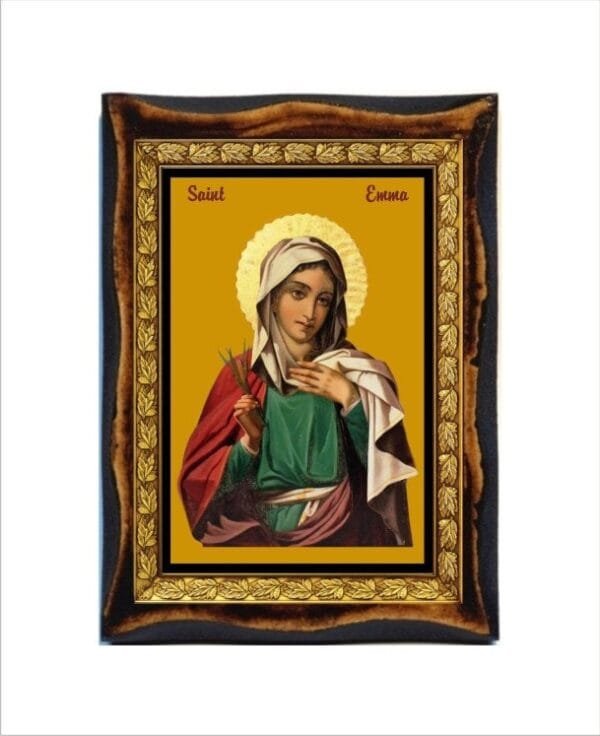


Hemma of Gurk
Our company offers wholesale sales for Monasteries, Exhibitions, Ecclesiastical Stores, Gift Shops, and Merchants. We provide competitive pricing based on the quantities you order, ensuring the best possible offer to meet your needs.
For more details on our products and to receive personalized offers, please contact us directly. We are happy to discuss terms and provide the best solutions tailored to you.
St Hemma – Saint Emma – Emma of Gurk – Sainte Emma – Emma di Gurk – Santa Emma – Emma de Gurk – Hemma von Gurk – Emma z Gurk
Dimensions: 11 x 8 cm – 4.33”x3.14”in , 15 x 11 cm – 5.9”x4.33”in , 21 x 15 cm – 8.3”x5.9”in , 27 x 21 cm – 10.6” X8.3”in – 42 x 32 cm – 16.5“x12.60”in
| Title | Range | Sale price |
|---|---|---|
| Total items | 5 - 10 | 15,20 € |
| Total items | 11 - 30 | 13,60 € |
| Total items | 31 - 60 | 12,00 € |
| Total items | 61 - 150 | 10,40 € |

Description
Hemma of Gurk (German: Hemma von Gurk; c. 995 – 27 June 1045), also called Emma of Gurk (Slovene: Ema Krška), was a noblewoman and founder of several churches and monasteries in the Duchy of Carinthia. Buried at Gurk Cathedral since 1174, she was beatified on 21 November 1287 and canonised on 5 January 1938 by Pope Pius XI. Her feast day is 27 June. Hemma is venerated as a saint by both the Catholic Church and the Eastern Orthodox Church, and as patroness of the current Austrian state of Carinthia.
Little is known about Hemma’s descent; she was probably born between 995 and 1000 (other sources mention 980 AD), her ancestors were related to the Bavarian Luitpoldings and thus to Emperor Henry II. Her grandmother Imma (Emma) was vested with market and minting rights at her estates in Lieding (today part of Straßburg) by Emperor Otto II in 975. The bestowal raised objections by the Archbishop of Salzburg and the privileges were later transferred to Gurk, Carinthia. According to her hagiography, Hemma was a member of a noble dynasty descending from Pilštanj (Peilenstein) in the Mark an der Sann (in present-day Slovenian Styria) and was brought up at the Imperial court in Bamberg by Empress Saint Cunigunde.
Hemma married the Carinthian count William II of Friesach, mentioned as margrave an der Sann in 1016, by whom she had two sons, Hartwig and William. Her husband had received vast estates on the Savinja (Sann) river from the hands of the Emperor. Both her sons and her husband were murdered, Margrave William II probably in 1036 by the deposed duke Adalbero of Carinthia in revenge. Hemma became wealthy through inheritance upon the death of her husband and sons.
Countess Hemma used her great wealth for the benefit of the poor and was already venerated as a saint during her lifetime. In addition, she founded ten churches throughout present-day Carinthia, Austria. In 1043 she founded the Benedictine double monastery of Gurk Abbey, where she withdrew during the last years of her life.
After her death, Gurk Abbey was dissolved by the Archbishop of Salzburg, Gebhard, who instead used the funds to set up the Diocese of Gurk-Klagenfurt in 1072. Admont Abbey, another Benedictine foundation in Austria, was founded in 1074 by the same Gebhard, and also owes its existence to Hemma’s wealth. Since 1174 Hemma’s relics have been buried in the crypt of Gurk Cathedral.
Additional Information
| Weight | N/A |
|---|---|
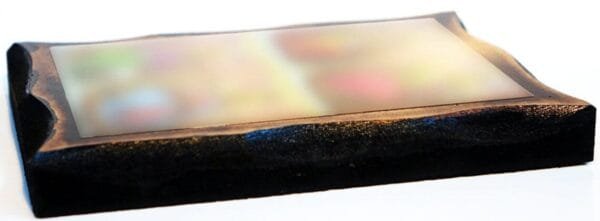
| Dimensions | 11cm x 8cm x 1.2cm, 15cm x 11cm x 1.7cm, 21cm x 15cm x 1.7cm, 27cm x 21cm x 1.7cm, 42cm x 32cm x 1.7cm |
There are no question found.
Related products


Phocas and Euphrosynus

Saint Akakios


Saint Cristiano


Xanthippi Spain
Seller


Rating & Review
There are no reviews yet.