
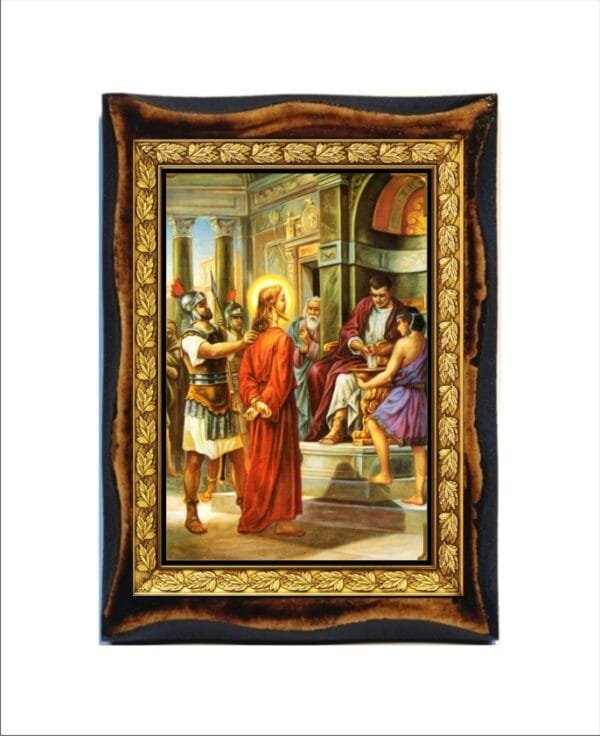




Jesus before Pilate and Herod
Our company offers wholesale sales for Monasteries, Exhibitions, Ecclesiastical Stores, Gift Shops, and Merchants. We provide competitive pricing based on the quantities you order, ensuring the best possible offer to meet your needs.
For more details on our products and to receive personalized offers, please contact us directly. We are happy to discuss terms and provide the best solutions tailored to you.
Dimensions: 11 x 8 cm – 4.33”x3.14”in , 15 x 11 cm – 5.9”x4.33”in , 21 x 15 cm – 8.3”x5.9”in , 27 x 21 cm – 10.6” X8.3”in – 42 x 32 cm – 16.5“x12.60”in
| Title | Range | Sale price |
|---|---|---|
| Total items | 5 - 10 | 15,20 € |
| Total items | 11 - 30 | 13,60 € |
| Total items | 31 - 60 | 12,00 € |
| Total items | 61 - 150 | 10,40 € |

Description
The Jews led Jesus to the residence of the Roman statuary Pilate, who did not enter strictly religious Jews, in order not to defile themselves (John 18:28). Jesus, however, had to go to the Richthaus.
In interrogation before Pilate, Jesus pointed out that his kingdom was not of this world, and that he was not pursuing secular domination claims. Pilate thought him innocent, and passed him to King Herod. The opposing rulers Herod and Pilate, who had been hostile to each other, became friends on this day (Lk 23:12) – the secular powers united against the Lord.
The Son of God was scourged by the Romans. The people demanded his crucifixion and charged him to rise up against the Emperor as the “king of the Jews”, whereupon the death penalty stood (Jn 19:12). Pilate saw a way to give Jesus freedom: the people should decide whether Jesus or the Barabbas criminals would be released. The people, incited by the high priests and elders, chose Barabbas. To show that he was not responsible for the following, Pilate washed his hands before the people and said, “I am innocent of his blood; “The people answered,” His blood is upon us and our children! “(Mt 27:24, 25). Pilate had Jesus rebelled and gave him the crucifixion.
Through the participation of the Roman priest, the condemnation and execution of Jesus are not only the matter of Israel, but also the Gentiles are involved. Man is simply guilty of the Lord’s death.
Additional Information
| Weight | N/A |
|---|---|
| Dimensions | 11cm x 8cm x 1.2cm, 15cm x 11cm x 1.6cm, 21cm x 15cm x 1.6cm, 27cm x 21cm x 1.6cm, 42cm x 32cm x 1.6cm |
There are no question found.


Rating & Review
There are no reviews yet.