
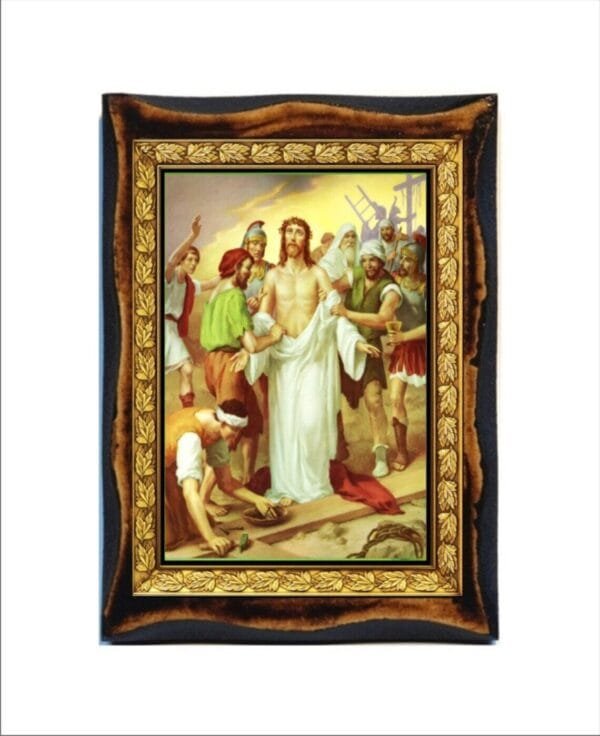





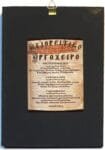
Jesus is robbed of his clothes
Our company offers wholesale sales for Monasteries, Exhibitions, Ecclesiastical Stores, Gift Shops, and Merchants. We provide competitive pricing based on the quantities you order, ensuring the best possible offer to meet your needs.
For more details on our products and to receive personalized offers, please contact us directly. We are happy to discuss terms and provide the best solutions tailored to you.
Jesus – Carries – His Cross – Comforts – the Women Following Him – Handmade – Wood Plaque – Orthodox – Catholic
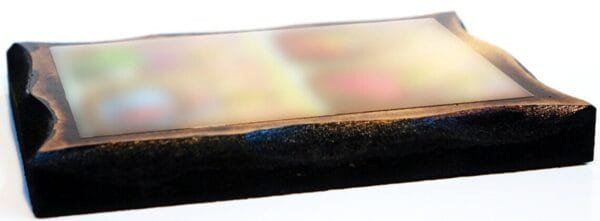
Dimensions: 11 x 8 cm – 4.33”x3.14”in , 15 x 11 cm – 5.9”x4.33”in , 21 x 15 cm – 8.3”x5.9”in , 27 x 21 cm – 10.6” X8.3”in – 42 x 32 cm – 16.5“x12.60”in
| Title | Range | Sale price |
|---|---|---|
| Total items | 5 - 10 | 15,20 € |
| Total items | 11 - 30 | 13,60 € |
| Total items | 31 - 60 | 12,00 € |
| Total items | 61 - 150 | 10,40 € |

Description
This Icon is a copy of the Hagiography (Holy Card Printing) that we have made in our Laboratory and we reserve the exclusive rights to reproduce these images, which are protected by copyright.
Jesus is stripped of his garments. Clothing gives a man his social position; it gives him his place in society, it makes him someone. His public stripping means that Jesus is no longer anything at all, he is simply an outcast, despised by all alike. The moment of the stripping reminds us of the expulsion from Paradise: God’s splendour has fallen away from man, who now stands naked and exposed, unclad and ashamed. And so Jesus once more takes on the condition of fallen man. Stripped of his garments, he reminds us that we have all lost the “first garment” that is God’s splendour. At the foot of the Cross, the soldiers draw lots to divide his paltry possessions, his clothes. The Evangelists describe the scene with words drawn from Psalm 22:19; by doing so they tell us the same thing that Jesus would tell his disciples on the road to Emmaus: that everything takes place “according to the Scriptures”. Nothing is mere coincidence; everything that happens is contained in the Word of God and sustained by his divine plan. The Lord passes through all the stages and steps of man’s fall from grace, yet each of these steps, for all its bitterness, becomes a step towards our redemption: this is how he carries home the lost sheep. Let us not forget that John says that lots were drawn for Jesus’s tunic, “woven without seam from top to bottom” (Jn 19:23). We may consider this as a reference to the High Priest’s robe, which was “woven from a single thread”, without stitching (Fl. Josephus, a III, 161). For he, the Crucified One, is the true High Priest.
Additional Information
| Weight | N/A |
|---|---|
| Dimensions | 11cm x 8cm x 1.2cm, 15cm x 11cm x 1.7cm, 21cm x 15cm x 1.7cm, 27cm x 21cm x 1.7cm, 42cm x 32cm x 1.7cm |
There are no question found.


Rating & Review
There are no reviews yet.