




Saint Dymphna
Our company offers wholesale sales for Monasteries, Exhibitions, Ecclesiastical Stores, Gift Shops, and Merchants. We provide competitive pricing based on the quantities you order, ensuring the best possible offer to meet your needs.
For more details on our products and to receive personalized offers, please contact us directly. We are happy to discuss terms and provide the best solutions tailored to you.
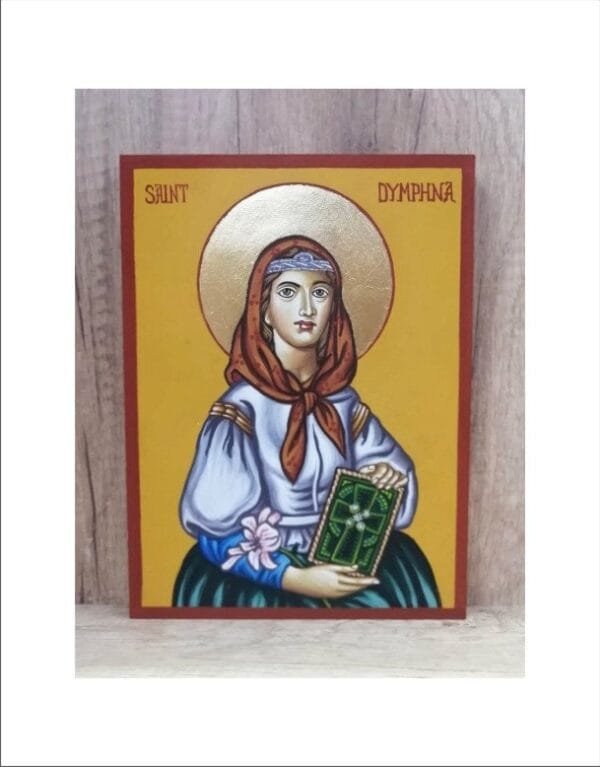
Santa Dinfna – Dymphne de Geel – Lily of Éire – Święta Dymfna – Santa Dimpna Verge Handmade and Hand Painted Original Icon
24cm x 18cm – 9.45″x 7.08″ inches

Description
Handmade and Hand Painted Icon
This icon is a work of Christian art and is a Holy religious item blessed from Christian Church.
Is entirely hand painted on a piece of wood the dimensions are 24cm x 18cm – 9.45″x 7.08″ inches and the materials used for painting are eggtempera and gold leaf 24k.
The Icons have a 24k gold leaf in the halos and the ocher background colour is with egg tempera.
Every Holy Icon takes to complete 10 to 15 days depending on the size and type of the background.
The HolySpiritArt retains sole rights to reproduce these images, all of which are copyrighted.
Saint Dymphna – Santa Dinfna – Dymphne de Geel – Lily of Éire – Święta Dymfna – Santa Dimpna Verge i Màrtir – Santa Dimpna de Irlanda – Saint Dymphna of Ireland – Sainte Dymphne de Geel – Santa Dimpna Verge i Màrtir – Handmade and Hand Painted Original Icon
Saint Dymphna is a Christian saint honoured in Catholic and Orthodox traditions. According to tradition, she lived in the 7th century. She was murdered by her father.
The story of St. Dymphna was first recorded in the 13th century by a canon of the Church of St. Aubert at Cambrai, France. It was commissioned by Guiard of Laon (1238–1248), the Bishop of Cambrai.
The author expressly stated that his work was based upon a long-standing oral tradition as well as a persuasive history of miraculous healings of the mentally ill.
According to Christian tradition, St. Dymphna was born in Ireland in the 7th century. Dymphna’s father Damon was a petty king of Oriel. Her mother was a devout Christian.
When St. Dymphna was 14 years old, she consecrated herself to Christ and took a vow of chastity. Shortly thereafter, her mother died. Damon had loved his wife deeply, and in the aftermath of her death his mental health sharply deteriorated. Eventually the king’s counsellors pressed him to remarry. Damon agreed, but only on the condition that his bride would be as beautiful as his deceased wife. After searching fruitlessly, Damon began to desire his daughter because of her strong resemblance to her mother.
When St. Dymphna learned of her father’s intentions, she swore to uphold her vows and fled his court along with her confessor Father Gerebernus, two trusted servants, and the king’s fool. Together they sailed towards the continent, eventually landing in what is present-day Belgium, where they took refuge in the town of Geel.
One tradition states that once settled in Geel, St. Dymphna built a hospice for the poor and sick of the region. However, it was through the use of her wealth that her father would eventually ascertain her whereabouts, as some of the coins used enabled her father to trace them to Belgium. Damon sent his agents to pursue his daughter and her companions. When their hiding place was discovered, Damon travelled to Geel to recover his daughter. Damon ordered his soldiers to kill Gerebernus and tried to force St. Dymphna to return with him to Ireland, but she resisted. Furious, Damon drew his sword and struck off his daughter’s head. She was said to have been 15 years old when she died. After St. Dymphna and Gerebernus were martyred, the residents of Geel buried them in a nearby cave. Years later, they decided to move the remains to a more suitable location. Some of her remains are at the shrine to Dymphna in Massillon, Ohio, United States.
The remains of St. Dymphna were later put into a silver reliquary and placed in a church in Geel named in her honour. The remains of Gerebernus were moved to Xanten, Germany. During the late 15th century the original St. Dymphna Church in Geel burned down. A second “Church of St. Dymphna” was then built and consecrated in 1532. The church still stands on the site where her body is believed to have first been buried.
According to nineteenth century Irish Catholic priest John Canon O’Hanlon, the commemoration of St. Dympna’s and of St. Gerebern’s arrival at Antwerp was celebrated on April 11, according to a Carthusian Martyrology, however their chief feast day was on May 15, the day of their final martyrdom. According to tradition, miracles occurred immediately after St. Dymphna’s tomb was discovered.
St. Dymphna is known as the Lily of Éire, due to her spotless virtue. She is traditionally portrayed wearing a crown, dressed in ermine and royal robes, and holding a sword. In modern versions she holds the sword awkwardly, as it symbolises her martyrdom, but in the older versions seen on numerous statues and stained glass images, her sword is pricking the neck of a demon; symbolising her title of Demon Slayer. She is also often portrayed holding a lamp, with the chained devil at her feet.
Some modern holy cards portray St. Dymphna in green and white, holding a book and white lilies.
Additional Information
| Weight | 1 kg |
|---|
There are no question found.








Rating & Review
There are no reviews yet.