
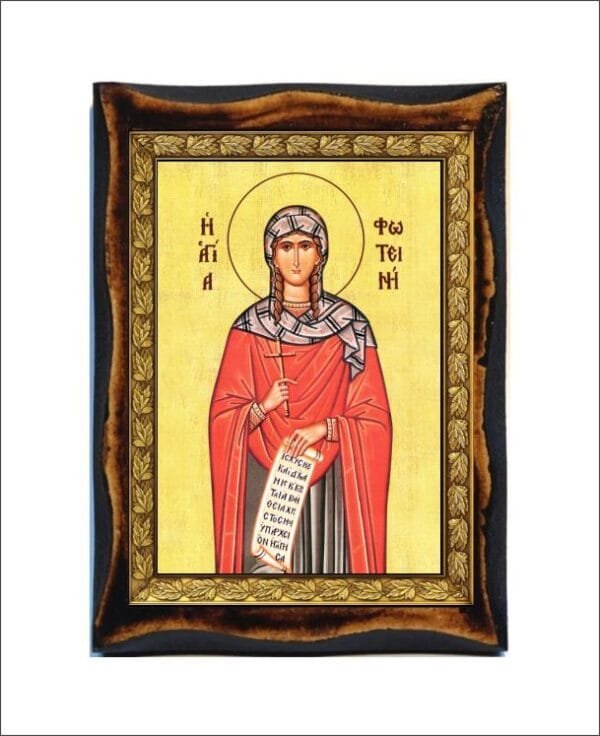

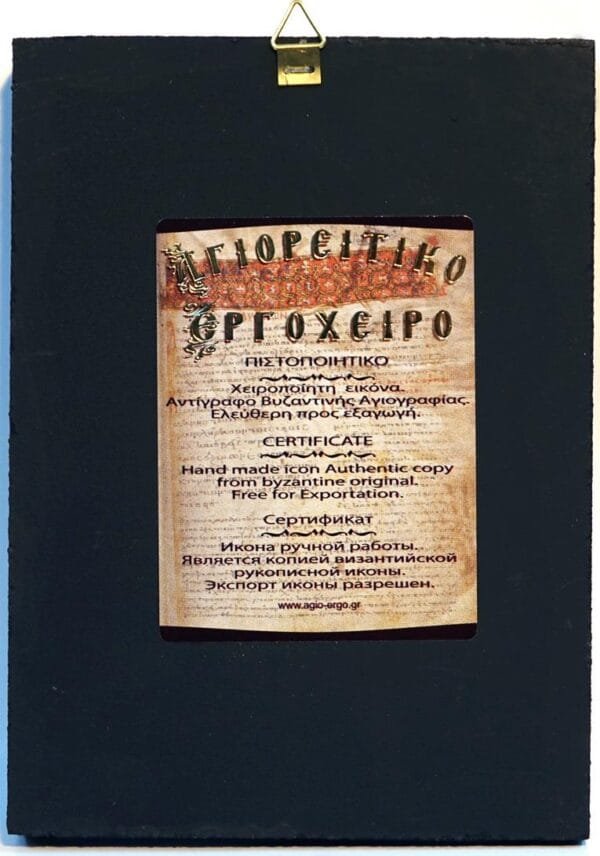
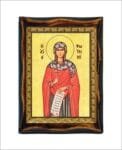



Saint Fotini
Our company offers wholesale sales for Monasteries, Exhibitions, Ecclesiastical Stores, Gift Shops, and Merchants. We provide competitive pricing based on the quantities you order, ensuring the best possible offer to meet your needs.
For more details on our products and to receive personalized offers, please contact us directly. We are happy to discuss terms and provide the best solutions tailored to you.
San Fotini – Santa Fotini – São Fotini – Święty Fotin i- Sfântul Fotini – Святой Фотини
Dimensions: 11 x 8 cm – 4.33”x3.14”in , 15 x 11 cm – 5.9”x4.33”in , 21 x 15 cm – 8.3”x5.9”in , 27 x 21 cm – 10.6” X8.3”in – 42 x 32 cm – 16.5“x12.60”in
| Title | Range | Sale price |
|---|---|---|
| Total items | 5 - 10 | 15,20 € |
| Total items | 11 - 30 | 13,60 € |
| Total items | 31 - 60 | 12,00 € |
| Total items | 61 - 150 | 10,40 € |

Description
Saint Fotini the Samaritan is a Great Martyr and Co-Apostle of the Christian Church. It is about the humble “woman from Samaria” with whom Jesus Christ spoke near Jacob’s Well or “Jacob’s well”, as mentioned in the Gospel according to John. Her real name, like other historical evidence, is unknown. The Church commemorates her every year on February 26 and commemorates this event on “Samaritan Sunday”, the fourth Sunday after Easter.
According to the Gospel passage, Jesus was traveling from Judea to Galilee. Arriving outside a town of Samaria, called Sychar or Shechem, he sat down near Jacob’s well to rest. Then a Samaritan woman went to draw water from the well and Jesus asked her to give him a drink. She was puzzled because Jews and Samaritans avoided all communication because of old enmity. During their conversation,Jesus revealed to her that He gives the “living water”, that whoever drinks it will never thirst but will have water of eternal life springing up inside him, as well as aspects of her personal life. After He made His teaching known to her, the Samaritan woman believed in Him. He was baptized with the name Fotini and became a preacher of the Gospel.
According to the ecclesiastical tradition, which echoes in Minaea, Saint Fotini was martyred under Nero, together with her five sisters and her two sons, Ios and Victor, in Rome. Also, it contains a long story about the action of Saint Fotini, which, however, probably does not resonate with real history.Thus Saint Fotini is reported to have preached the gospel, after her son Iosia, in Carthagena in Africa (the well-known Carthage), as did the Duke and his brother Victor. They were all arrested together and taken to Rome, where they were tortured.
In Smyrna, the tradition is preserved that Saint Fotini taught and was martyred there. For this reason the church of Agia Fotini of Smyrna was dedicated to her. A characteristic feature of the temple was the 33-meter spire with the large striking clock. The temple burned in the great fire that incinerated the Greek quarter in September 1922.
After the Asia Minor Catastrophe, the refugee settlers of New Smyrna built the church of Agia Fotini, in memory of the church of the same name in Smyrna. Inside the current church are the wood-carved iconostasis, the episcopal throne and the pulpit from the ruined church of Agios Ioannis the Theologians of Apano Mahalas of Smyrna.These were moved with the coordinated actions of the State, Priests and residents and are identical to those housed in the destroyed church of Agia Fotini Smyrna.
In 1974, when a separate Holy Metropolis of Nea Smyrna was created, the church of Agia Fotini was established as the Metropolitan Church. In 1996, the 33-meter bell tower was erected with a contribution from the non-profit Onassis Foundation, a true copy of the historical bell tower of the church of Agia Fotini in Smyrna, which was destroyed in 1922.
Additional Information
| Weight | N/A |
|---|---|
| Dimensions | 11cm x 8cm x 1.2cm, 15cm x 11cm x 1.7cm, 21cm x 15cm x 1.7cm, 27cm x 21cm x 1.7cm, 42cm x 32cm x 1.7cm |
There are no question found.
Related products


Saint Layla


Phocas Gardener


Xanthippi Spain
Seller


Rating & Review
There are no reviews yet.