
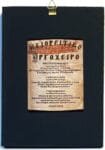
Moses of Novgorod
Our company offers wholesale sales for Monasteries, Exhibitions, Ecclesiastical Stores, Gift Shops, and Merchants. We provide competitive pricing based on the quantities you order, ensuring the best possible offer to meet your needs.
For more details on our products and to receive personalized offers, please contact us directly. We are happy to discuss terms and provide the best solutions tailored to you.
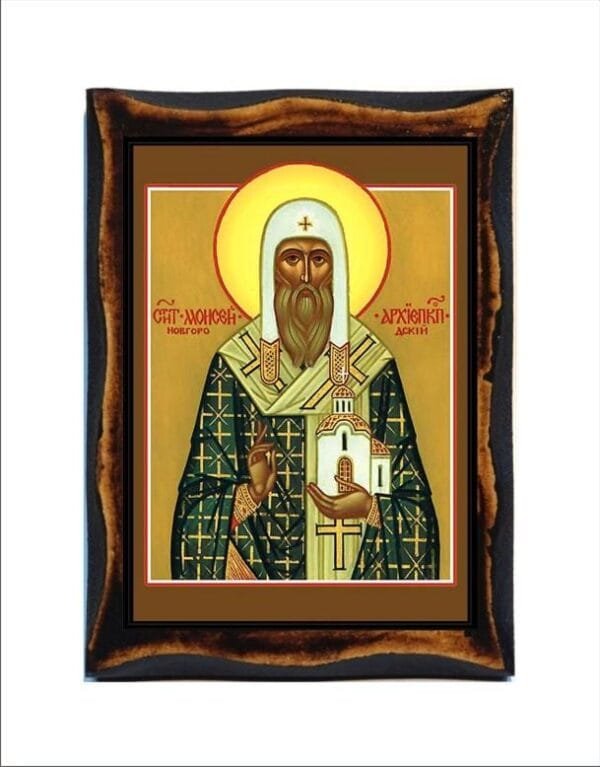
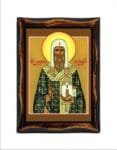
Saint Moses – Archbishop of Novgorod – Archbishop Moses – Saint Moses – Moses the Archbishop of Novgorod
Dimensions: 11 x 8 cm – 4.33”x3.14”in , 15 x 11 cm – 5.9”x4.33”in , 21 x 15 cm – 8.3”x5.9”in , 27 x 21 cm – 10.6” X8.3”in – 42 x 32 cm – 16.5“x12.60”in
| Title | Range | Sale price |
|---|---|---|
| Total items | 5 - 10 | 15,20 € |
| Total items | 11 - 30 | 13,60 € |
| Total items | 31 - 60 | 12,00 € |
| Total items | 61 - 150 | 10,40 € |

Description
Saint Moses, Archbishop of Novgorod (1325-1330, 1352-1359), in the world Metrophanes, was born at Novgorod. In his youth he secretly left his home and entered Tver’s Otroch monastery, where he became a monk. His parents found him, and at their insistence he transferred to a monastery near Novgorod. At this monastery he was ordained as a hieromonk, and later he was appointed archimandrite of the Yuriev monastery.
After the death of Archbishop David of Novgorod, Saint Peter (December 21) consecrated Moses as Archbishop of Novgorod in 1325. This was the first episcopal consecration to be performed in Moscow. Saint Moses did not guide his Novgorod flock for long, however. The quarrels and contentious factions, the conflagrations and other misfortunes weighed heavily on his soul, which sought monastic solitude. After four years, he petitioned to be allowed to retire and live in asceticism. He was succeeded by Saint Basil.
In 1330 the saint withdrew to the Kolmov monastery for tranquillity. He did not remain here very long, either. He found a desolate spot at Derevyanitsa, where he built the stone church of the Resurrection of Christ. At this place the monk spent more than twenty years at monastic deeds. After Basil’s death, Saint Moses yielded to the requests of the Novgorod people to be their archpastor once again. The ancient chronicler describes Saint Moses in this way: “He shepherded his flock as a good pastor; he defended the downtrodden, and protected destitute widows; he employed a company of copyists, and because of him many books were written, and he confirmed many in piety by his guidance.”
In the year 1354 Patriarch Philotheus of Constantinople (1354-1355, 1364-1376), as a token of his deep respect for Saint Moses gave him permission to wear polystavrion vestments (“many crosses”), and even sent him a set. He also permitted Saint Moses to deal directly with the Patriarch of Constantinople without intermediaries.
According to the Book of Exodus, Moses was born in a time when his people, the Israelites, an enslaved minority, were increasing in numbers and the Egyptian Pharaoh was worried that they might ally themselves with Egypt’s enemies.[5] Moses’ Hebrew mother, Jochebed, secretly hid him when the Pharaoh ordered all newborn Hebrew boys to be killed in order to reduce the population of the Israelites. Through the Pharaoh’s daughter (identified as Queen Bithia in the Midrash), the child was adopted as a foundling from the Nile river and grew up with the Egyptian royal family. After killing an Egyptian slavemaster (because the slavemaster was smiting a Hebrew to death), Moses fled across the Red Sea to Midian, where he encountered The Angel of the Lord,[6] speaking to him from within a burning bush on Mount Horeb (which he regarded as the Mountain of God).
Additional Information
| Weight | N/A |
|---|---|
| Dimensions | 11cm x 8cm x 1.2cm, 15cm x 11cm x 1.7cm, 21cm x 15cm x 1.7cm, 27cm x 21cm x 1.7cm, 42cm x 32cm x 1.7cm |
There are no question found.





Rating & Review
There are no reviews yet.