
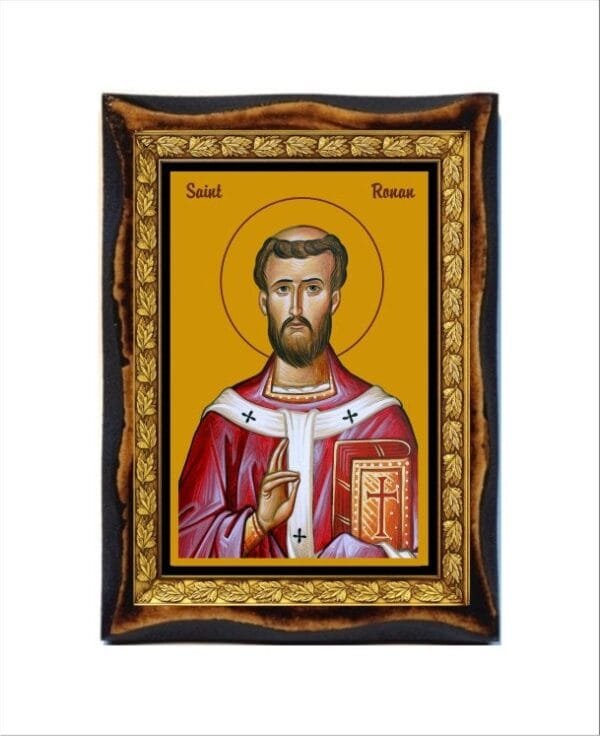
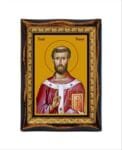
Saint Ronan
Our company offers wholesale sales for Monasteries, Exhibitions, Ecclesiastical Stores, Gift Shops, and Merchants. We provide competitive pricing based on the quantities you order, ensuring the best possible offer to meet your needs.
For more details on our products and to receive personalized offers, please contact us directly. We are happy to discuss terms and provide the best solutions tailored to you.
Ronan of Locronan – Saint Renan – Ronano di Quimper – San Ronano – Ronan de Locronan – Ronan von Locronan – Ronano di Locronan
Dimensions: 11 x 8 cm – 4.33”x3.14”in , 15 x 11 cm – 5.9”x4.33”in , 21 x 15 cm – 8.3”x5.9”in , 27 x 21 cm – 10.6” X8.3”in – 42 x 32 cm – 16.5“x12.60”in
| Title | Range | Sale price |
|---|---|---|
| Total items | 5 - 10 | 15,20 € |
| Total items | 11 - 30 | 13,60 € |
| Total items | 31 - 60 | 12,00 € |
| Total items | 61 - 150 | 10,40 € |

Description
Saint Ronan (fl. c. sixth century?) was an Irish pilgrim saint and hermit in western Brittany. He was a son of Saint Berach and the eponymous founder of Locronan and co-patron of Quimper (France), together with its founder, Saint Corentin.
From Locronan to Quimper
The village of Locronan (lit. “the place of Ronan”), which is located about 17 km northwest of Quimper, owes its name to its reputed founder, the Irish pilgrim Ronan. To judge by his entry in the cartulary of the abbey of Quimper, he is known to have been venerated at Locronan since at least the 1030s.
At some later stage, his remains were translated to the nearby abbey of Quimper, whose patron saint was St Corentin. This must have occurred by 1274 at the latest, when the abbey produced an inventory mentioning the saint’s body and head among its cherished relics.
Sometime in the same century, a Latin life of the saint, the Vita S. Ronani, was written at Quimper to familiarise the local community with the origins of the saint and his posthumous importance for the town through the miracles wrought by his relics.
Scenes from the life of St Ronan on the polychrome pulpit at the Locronan parish church. One scene portrays the episode in which Keban charged the saint with lycanthropy.
More scenes on the Locronan pulpit. The discovery of his daughter hidden in a chest is shown in the first picture. The dragging of his body to Locronan is in the third picture.
Life
The text begins by telling that Ronan was a well-educated native of Ireland whose good works as a bishop had brought him great renown in his home country (§ 1). However, he longed to have a closer communion with God and so, at the height of his career in Ireland, he chose voluntary exile, per Genesis 12:1–3, by severing all ties with kin and country and embarking on a voyage to Brittany. Having landed “in the region of Léon”, he continued his journey southwards to the kingdom of Cornouaille (Latin Cornubia) and set up a hermitage at what would become known as Locronan, near the woods of Névez. Here he devoted himself to prayer and an ascetic way of life, through which he soon attracted a multitude of admirers from the region (§ 2). In this way, his presence also came to the attention of Gradlon, king of Cornouaille and a prominent figure in Breton legend
Additional Information
| Weight | N/A |
|---|---|
| Dimensions | 11cm x 8cm x 1.2cm, 15cm x 11cm x 1.7cm, 21cm x 15cm x 1.7cm, 27cm x 21cm x 1.7cm, 42cm x 32cm x 1.7cm |
There are no question found.




Rating & Review
There are no reviews yet.