
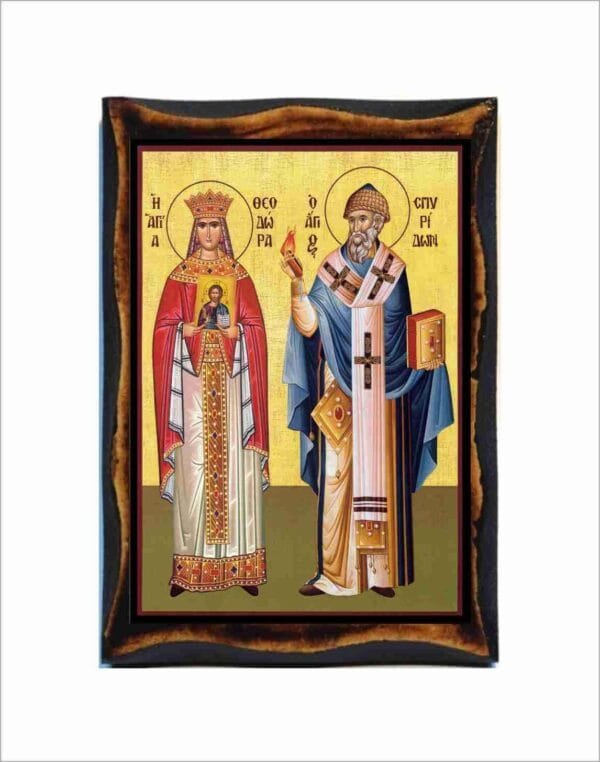

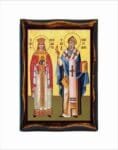

Saints Spyridon and Theodora
Our company offers wholesale sales for Monasteries, Exhibitions, Ecclesiastical Stores, Gift Shops, and Merchants. We provide competitive pricing based on the quantities you order, ensuring the best possible offer to meet your needs.
For more details on our products and to receive personalized offers, please contact us directly. We are happy to discuss terms and provide the best solutions tailored to you.
Saints Spyridon and Theodora – Spyridon of Tremithus – Santo Spiridione – Santa Teodora – San Espiridion – Sfântul Spiridon – Theodora Augusta
Dimensions: 11 x 8 cm – 4.33”x3.14”in , 15 x 11 cm – 5.9”x4.33”in , 21 x 15 cm – 8.3”x5.9”in , 27 x 21 cm – 10.6” X8.3”in – 42 x 32 cm – 16.5“x12.60”in
| Title | Range | Sale price |
|---|---|---|
| Total items | 5 - 10 | 15,20 € |
| Total items | 11 - 30 | 13,60 € |
| Total items | 31 - 60 | 12,00 € |
| Total items | 61 - 150 | 10,40 € |

Description
Spyridon, also Spyridon of Tremithus (Greek: Ἅγιος Σπυρίδων; c. 270 – 348) is a saint honoured in both the Eastern and Western Christian traditions.
Spyridon was born in Assia, in Cyprus. He worked as a shepherd and was known for his great piety. He married and had one daughter, Irene. Upon the death of his wife, Spyridon entered a monastery, and their daughter entered a convent.
Spyridon eventually became Bishop of Trimythous, or Tremithous (today called Tremetousia), in the district of Larnaca. He took part in the First Ecumenical Council of Nicaea (325), where he was instrumental in countering the theological arguments of Arius and his followers.
He reportedly converted a pagan philosopher to Christianity by using a potsherd to illustrate how one single entity (a piece of pottery) could be composed of three unique entities (fire, water and clay); a metaphor for the Christian doctrine of the Trinity.
As soon as Spyridon finished speaking, the shard is said to have miraculously burst into flame, water dripped on the ground, and only dust remained in his hand (other accounts of this event say that it was a brick he held in his hand).
After the council, Spyridon returned to his diocese in Tremithous. He later fell into disfavor during the persecutions of the emperor Maximinus, but died peacefully in old age.
Spyridon was popular in Byzantine literature. A poem, now lost, was dedicated to him by his pupil Triphyllios. It inspired two 7th-century vitae, one by Theodore of Paphos (c. 655) and another possibly by Leontios of Neapolis. The former was used by Simeon Metaphrastes. Arabic and Georgian hagiographies also survive.
Theodora (/ˌθiːəˈdɔːrə/; Greek: Θεοδώρα; c. 500 – 28 June 548) was a Byzantine empress by marriage to emperor Justinian. She became empress upon Justinian’s accession in 527 and was one of his chief advisers, albeit from humble origins. Along with her spouse, Theodora is a saint in the Eastern Orthodox Church and in the Oriental Orthodox Church, commemorated on 14 November and 28 June respectively. She is sometimes enumerated as Theodora I.
The main historical sources for her life are the works of her contemporary Procopius. The historian offered three different portrayals of the empress. The Wars of Justinian, largely completed in 545, paints a picture of a courageous and influential empress who saved the throne for Justinian.
Additional Information
| Weight | N/A |
|---|---|
| Dimensions | 11cm x 8cm x 1.2cm, 15cm x 11cm x 1.7cm, 21cm x 15cm x 1.7cm, 27cm x 21cm x 1.7cm, 42cm x 32cm x 1.7cm |
There are no question found.




Rating & Review
There are no reviews yet.