
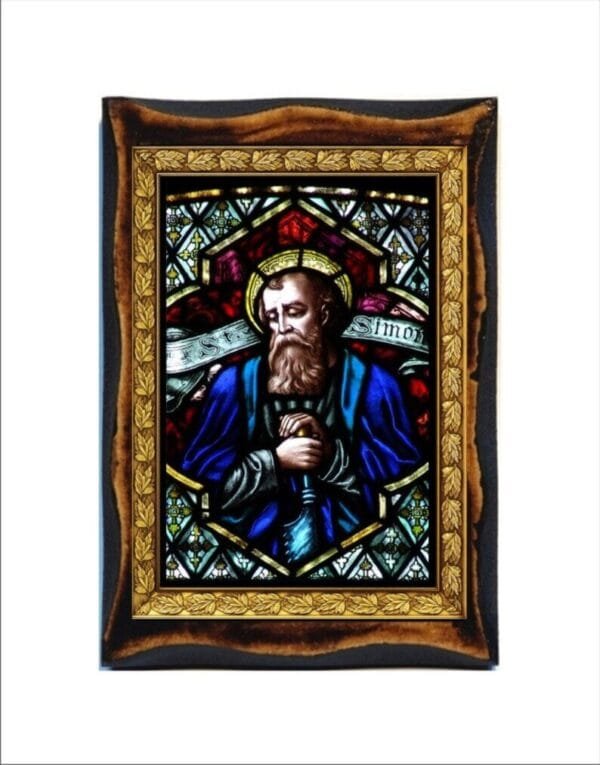



Simon the Zealot
Our company offers wholesale sales for Monasteries, Exhibitions, Ecclesiastical Stores, Gift Shops, and Merchants. We provide competitive pricing based on the quantities you order, ensuring the best possible offer to meet your needs.
For more details on our products and to receive personalized offers, please contact us directly. We are happy to discuss terms and provide the best solutions tailored to you.
Simon the Cananite – Simon le Zelote – Simone il Cananeo – San Simón – São Simão – Simon Zelotes – San Simon – Saint Simon
Dimensions: 11 x 8 cm – 4.33”x3.14”in , 15 x 11 cm – 5.9”x4.33”in , 21 x 15 cm – 8.3”x5.9”in , 27 x 21 cm – 10.6” X8.3”in – 42 x 32 cm – 16.5“x12.60”in
| Title | Range | Sale price |
|---|---|---|
| Total items | 5 - 10 | 15,20 € |
| Total items | 11 - 30 | 13,60 € |
| Total items | 31 - 60 | 12,00 € |
| Total items | 61 - 150 | 10,40 € |

Description
This Icon is a copy of the Hagiography (Holy Card Printing) that we have made in our Laboratory and we reserve the exclusive rights to reproduce these images, which are protected by copyright.
Simon the Zealot (Acts 1:13, Luke 6:15) or Simon the Cananite or Simon the Cananaean (Matthew 10:4, Mark 3:18; Greek: Σίμων ὁ Κανανίτης; Coptic: ⲥⲓⲙⲱⲛ ⲡⲓ-ⲕⲁⲛⲁⲛⲉⲟⲥ; Classical Syriac: ܫܡܥܘܢ ܩܢܢܝܐ) was one of the most obscure among the apostles of Jesus. A few pseudepigraphical writings were connected to him, but Saint Jerome does not include him in De viris illustribus written between 392–393 AD.
The name Simon occurs in all of the Synoptic Gospels and the Book of Acts each time there is a list of apostles, without further details:
Simon, (whom he also named Peter,) and Andrew his brother, James and John, Philip and Bartholomew, Matthew and Thomas, James the son of Alphaeus, and Simon called Zelotes, And Judas the brother of James, and Judas Iscariot, which also was the traitor.
To distinguish him from Simon Peter he is called Kananaios or Kananites, depending on the manuscript (Matthew 10:4 Mark 3:18), and in the list of apostles in Luke 6:15, repeated in Acts 1:13, Zelotes, the “Zealot”. Both titles derive from the Hebrew word קנאי qanai, meaning zealous, although Jerome and others mistook the word to signify the apostle was from the town of קנה Cana, in which case his epithet would have been “Kanaios”, or even from the region of כנען Canaan.[citation needed] As such, the translation of the word as “the Cananite” or “the Canaanite” is traditional and without contemporary extra-canonic parallel.[citation needed]
Robert Eisenman has pointed out contemporary talmudic references to Zealots as kanna’im “but not really as a group — rather as avenging priests in the Temple”. Eisenman’s broader conclusions, that the zealot element in the original apostle group was disguised and overwritten to make it support the assimilative Pauline Christianity of the Gentiles, are more controversial. John P. Meier points out that the term “Zealot” is a mistranslation and in the context of the Gospels means “zealous” or “jealous” (in this case, for keeping the Law of Moses), as the Zealot movement did not exist until 30 to 40 years after the events of the Gospels. However, neither Brandon, nor Hengel support this view, both independently concluding that the revolt by Judas of Galilee, arising from the census of Quirinius in 6 AD, was the ultimate origin of the Jewish freedom movement, which developed via the “Fourth Philosophy” group into the Zealots, even by the time of Jesus. Both of these researchers suggest that “Simon Zelotes” was indeed a Zealot belonging to this movement, and perhaps that other disciples were also. However, Hengel (in particular) concluded that Jesus himself was not a zealot, as much of his teaching was actually contrary to Fourth Philosophy views.
Additional Information
| Weight | N/A |
|---|---|
| Dimensions | 11cm x 8cm x 1.2cm, 15cm x 11cm x 1.7cm, 21cm x 15cm x 1.7cm, 27cm x 21cm x 1.7cm, 42cm x 32cm x 1.7cm |
There are no question found.


Rating & Review
There are no reviews yet.